

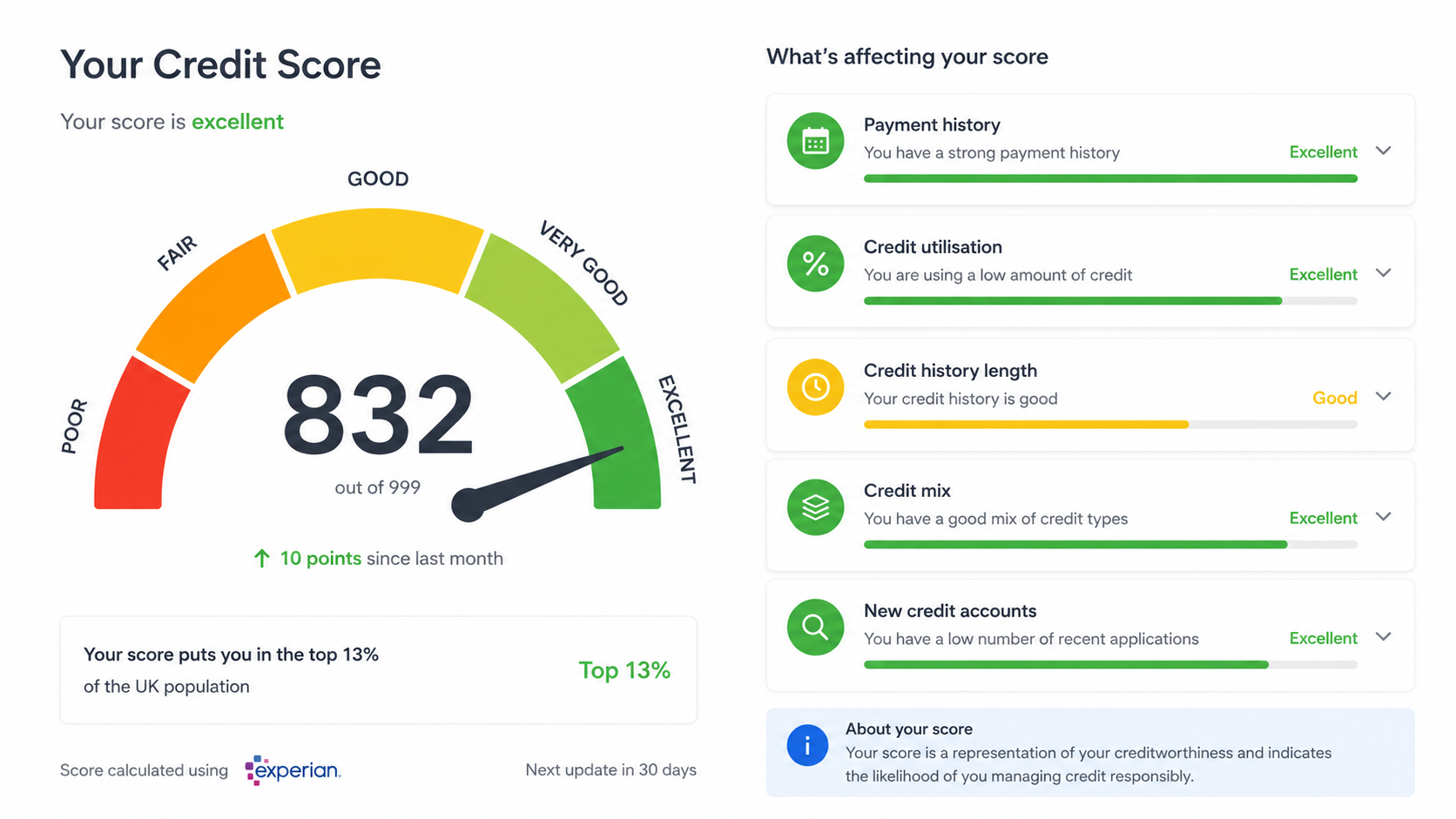
A credit score in the UK is a digital rating that represents your financial reliability to potential lenders.
Unlike other countries, the UK does not have a single, universal credit score; instead, three distinct credit reference agencies calculate independent scores based on your credit report data.
.
How Your Score is Calculated
The three main credit reference agencies in the UK use different scoring brackets, meaning your numerical score will vary depending on who a lender checks:
- Experian: Scores range from 0 to 999
- Equifax: Scores range from 0 to 1,000
- TransUnion: Scores range from 1 to 710
Lenders use these numerical scores alongside their own internal risk models to decide whether to approve you for credit cards, personal loans, or mortgages.
.
Key Factors That Affect Your Score
Your score reflects your financial history over the last 6 years. The calculation heavily weights specific habits:
- Payment History: Missing a payment or paying late severely damages your score.
- Credit Utilisation: This is the percentage of your limit that you actually use. Using more than 30% of your available credit limit suggests financial stress.
- Account Age: Older, well-managed accounts prove long-term stability.
- Credit Mix: Having a healthy balance of different credit types (like a credit card, mobile contract, and loan) can help.
- Hard Searches: Applying for multiple credit products in a short period triggers multiple “hard checks,” which lowers your score.
.
Concrete Steps to Improve Your Score
Building credit takes time, especially if you are new to the country or have no borrowing history. Use these steps to build your profile:
Secure Your Address History
- Register for the Electoral Roll: Sign up to vote via the GOV.UK Electoral Register at your current address. This is the fastest way to verify your identity. If you are a non-Commonwealth or non-EU citizen who cannot vote, you can manually add a “Notice of Correction” to your report explaining your visa status.
Manage Credit Utilization
- Keep Balances Low: Aim to use less than 30% of your limit. If your limit is £1,000, keep your balance under £300.
- Automate Payments: Set up Direct Debits for the minimum or full statement balance every month to guarantee you never miss a deadline.
Leverage Alternative Credit Builders
- Report Your Rent: Use services like Canopy, CreditLadder, or Experian Boost to report your monthly rent payments directly to credit bureaus.
- Use a Credit Builder Card: If you are rejected for standard cards, look into specialized credit-builder cards from providers like LOQBOX or opening a digital account with Bip or Zable. Spend small amounts on these cards and pay them off completely every month.
Monitor and Protect Your Profile
- Check Reports for Free: Use free platforms like ClearScore (for Equifax data), TotallyMoney (for TransUnion data), or Experian directly to audit your report for errors.
- Space Out Applications: Wait at least 3 to 6 months between credit applications to avoid looking desperate for funds.