


How Salaries Compare with Germany, Austria and Switzerland
When considering a move abroad, choosing a career, or comparing job opportunities, salary figures alone rarely tell the whole story. A higher wage in one country does not necessarily mean a higher standard of living once taxes, social insurance contributions, healthcare costs and living expenses are taken into account.
This guide compares wages in the United Kingdom, Germany, Austria and Switzerland, explains what deductions are made from salaries, and examines how much workers typically take home in each country.
.
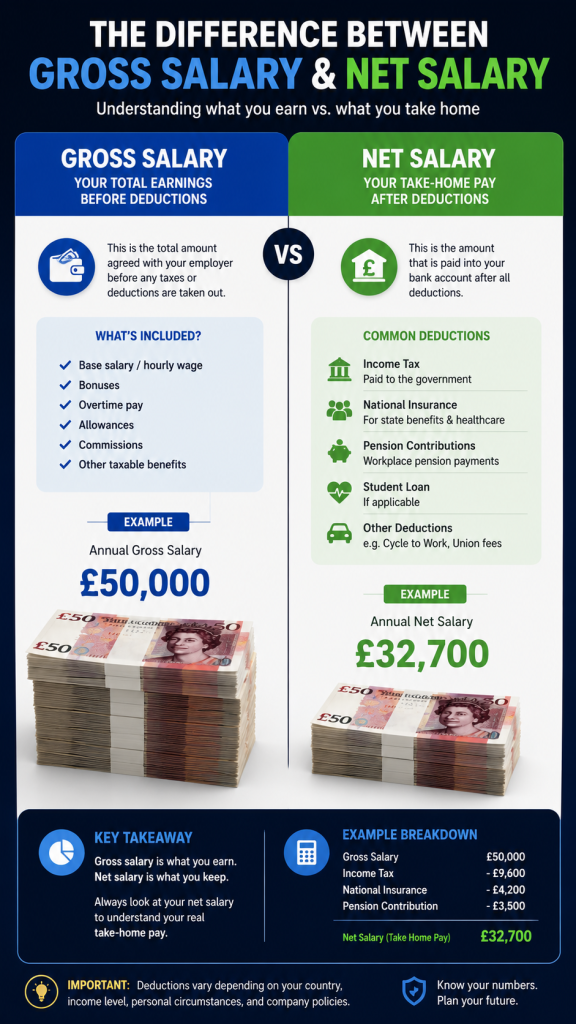
Gross Salary vs Net Salary
Before comparing countries, it is important to understand the difference between:
Gross Salary
The amount agreed with your employer before deductions.
Example:
£35,000 per year
.
Net Salary
The amount that arrives in your bank account after deductions.
This is often called:
- Take-home pay
- Nettolohn (Germany/Austria/Switzerland)
.
🇬🇧 Typical Salary Deductions in the United Kingdom
Employees pay:
Income Tax
Based on earnings.
England, Wales and Northern Ireland (2025/26)
- Personal Allowance: £12,570 tax-free
- Basic Rate: 20%
- Higher Rate: 40%
- Additional Rate: 45%
.
National Insurance
Used to fund:
- State Pension
- NHS
- Certain social benefits
Employees typically pay:
- 8% on most earnings above thresholds
.
What Is Not Deducted?
Unlike Germany, Austria and Switzerland, the UK generally does not deduct separately for:
- Health insurance
- Long-term care insurance
- Church tax
- Accident insurance
The NHS is funded largely through taxation.
.
🇩🇪 Typical Salary Deductions in Germany
Germany has one of Europe’s most comprehensive social insurance systems.
Employees contribute towards:
Income Tax (Lohnsteuer)
Based on salary and tax class.
- Pension Insurance (9.3% employee contribution)
- Health Insurance (8% employee contribution)
- Unemployment Insurance (1.3%)
- Long-Term Care Insurance (1.8% to 2.4%)
- Church Tax (Optional 8% or 9% of income tax if registered with a recognised church)
.
🇦🇹 Typical Salary Deductions in Austria
Employees contribute towards:
- Income Tax
- Pension Insurance
- Health Insurance
- Unemployment Insurance
Combined deductions can exceed 30% depending on earnings.
Austria also has the famous:
13th and 14th Salary
Many employees receive:
- Holiday pay
- Christmas bonus
These payments often enjoy favourable tax treatment.
.
🇨🇭 Typical Salary Deductions in Switzerland
Switzerland operates differently.
Deductions usually include:
- Federal tax
- Cantonal tax
- Municipal tax
- Pension contributions
- Unemployment insurance
- Accident insurance
In many cantons:
- Overall deductions are lower than Germany
- Net income is often significantly higher
However:
- Health insurance is purchased separately
- Housing costs can be substantially higher
.
Average Annual Salaries
Approximate averages for full-time employees.
| Country | Average Gross Salary |
|---|---|
| United Kingdom | £35,000 – £38,000 |
| Germany | €50,000 – €52,000 |
| Austria | €47,000 – €50,000 |
| Switzerland | CHF 80,000 – CHF 90,000 |
Switzerland consistently offers the highest average salaries in Europe.
.
Comparing Popular Occupations
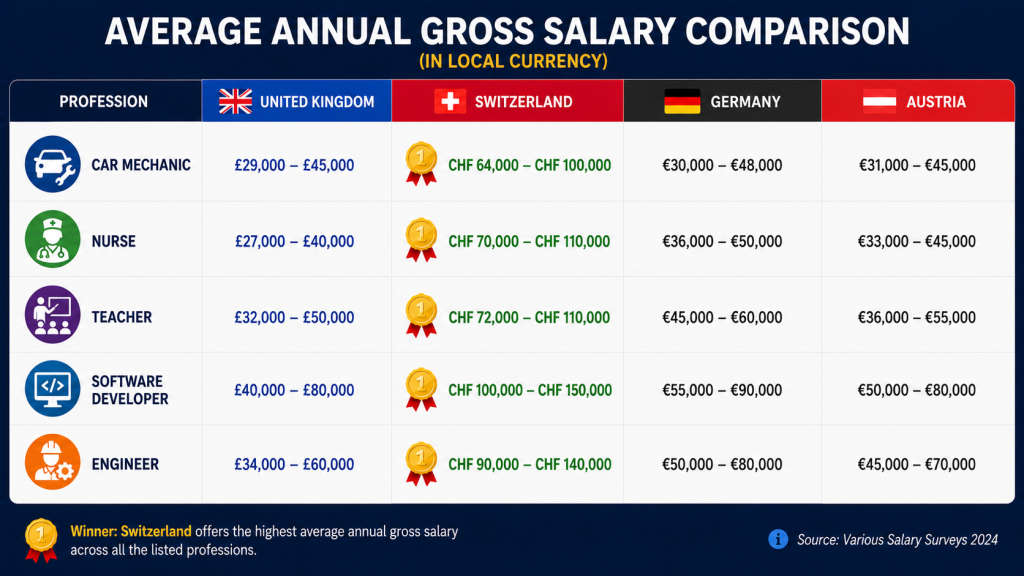
What you can spot here is that some of the most popular jobs don’t qualify for the Skilled Worker Visa because the starting salary is below the threshold.
.
Apprentice Wages
A particularly interesting comparison.
🇬🇧 United Kingdom
Apprentices often earn:
£14,000 – £22,000
depending on age and employer.
.
🇩🇪 Germany
Apprentices receive an Ausbildungsvergütung.
Example:
Car Mechanic Apprentice
- Year 1: €850 – €1,100
- Year 2: €950 – €1,250
- Year 3: €1,100 – €1,450
- Year 4: €1,250 – €1,600
.
🇦🇹 Austria
Similar system to Germany.
Typical range:
€900 – €1,500 per month
depending on trade and year.
.
🇨🇭 Switzerland
Apprentice wages vary considerably.
Typical range:
CHF 700 – CHF 1,800 per month
depending on profession and training year.
.
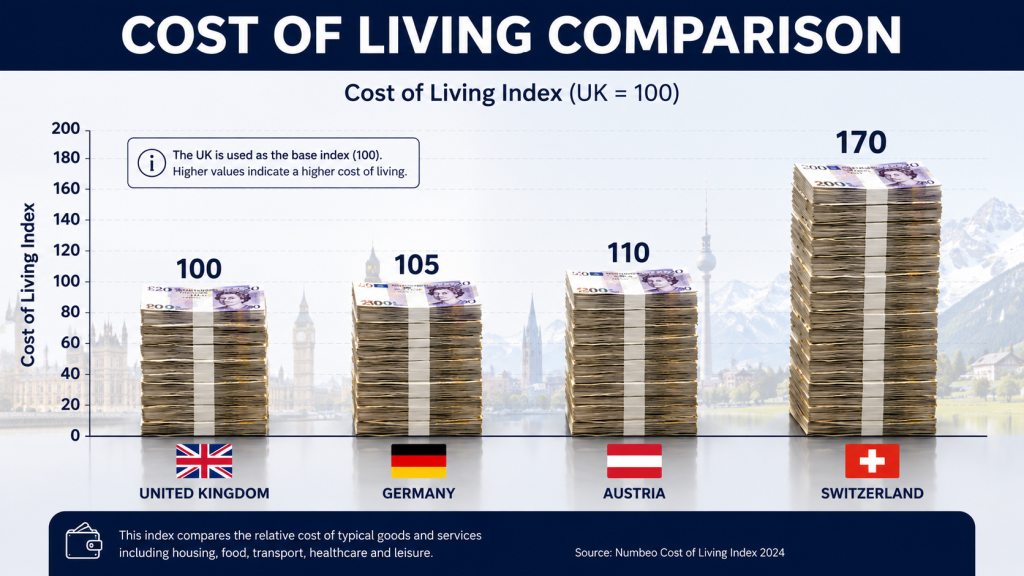
Cost of Living Comparison
Higher salaries do not always mean greater purchasing power.
.
Example: Monthly Rent
One-bedroom city centre apartment.
🇬🇧 United Kingdom: £900 – £1,500
🇩🇪 Germany: €800 – €1,400
🇦🇹 Austria: €800 – €1,300
🇨🇭 Switzerland: CHF 1,500 – CHF 3,000
.
Purchasing Power
Many economists consider Switzerland the winner despite high costs because wages rise faster than living expenses.
A Swiss engineer, nurse or software developer typically retains significantly more disposable income than counterparts in the UK, Germany or Austria.
For middle-income workers:
- 🇨🇭 Switzerland
- 🇩🇪 Germany
- 🇦🇹 Austria
- 🇬🇧 United Kingdom
is often the ranking for disposable income after essential expenses.
.
Benefits Included by Employers
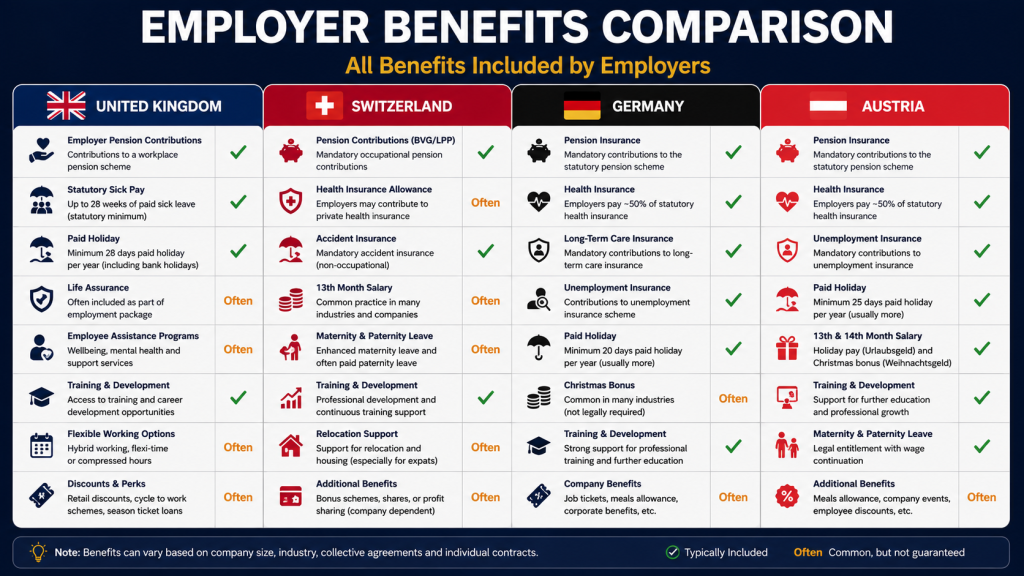
🇬🇧 United Kingdom
Common benefits:
- Pension scheme
- Paid holidays
- Sick pay (only with larger employers)
- NHS access
.
🇩🇪 Germany
Common benefits:
- Extensive social protection
- Health insurance
- Pension contributions
- Long-term care insurance
.
🇦🇹 Austria
Common benefits:
- Social insurance
- 13th salary
- 14th salary
.
🇨🇭 Switzerland
Common benefits:
- Pension contributions
- Accident insurance
- High salaries
Health insurance is usually paid separately by the employee.
.
Which Country Pays Best?
Highest Gross Salary
🥇 🇨🇭 Switzerland
Highest Net Salary
🥇 🇨🇭 Switzerland
Strongest Social Safety Net
🥇 🇩🇪 Germany and 🇦🇹 Austria
Lowest Complexity
🥇 🇬🇧 United Kingdom
Best Purchasing Power
🥇 🇨🇭 Switzerland
.
Final Thoughts
The United Kingdom offers a relatively simple taxation system and free healthcare through the NHS, but average salaries are generally lower than those in Germany, Austria and especially Switzerland.
Germany and Austria provide strong worker protections and extensive social benefits, although deductions from wages can be significant.
Switzerland consistently offers the highest salaries and strongest purchasing power, but employees face higher housing costs and must arrange their own health insurance.
When comparing job offers internationally, always compare net income, social benefits, healthcare costs and living expenses rather than focusing solely on gross salary figures.