
How They Compare with Germany, Austria and Switzerland
If you are moving to the United Kingdom, applying for jobs, considering university study, or comparing educational qualifications across Europe, understanding the UK’s education system can be challenging.
This guide explains GCSEs, A-Levels and other British qualifications, and compares them with the equivalent qualifications in Germany, Austria and Switzerland.
.
What Are GCSEs?
GCSE stands for General Certificate of Secondary Education.
GCSEs are the main qualifications taken by pupils in England, Wales and Northern Ireland at the end of compulsory secondary education.
Students typically sit GCSE examinations at age 15 to 16 after completing Year 11.
Most pupils study between:
- 8 and 12 GCSE subjects
- English Language
- English Literature
- Mathematics
- Sciences
- History or Geography
- Modern Foreign Languages
- Various optional subjects
.
GCSE Grading System
Since 2017, GCSEs in England are graded using a numerical system.
| Grade | Equivalent Old Grade |
|---|---|
| 9 | Higher than A* |
| 8 | Between A* and A |
| 7 | A |
| 6 | B |
| 5 | Strong C / Low B |
| 4 | Standard Pass (C) |
| 3 | D |
| 2 | E/F |
| 1 | G |
| U | Ungraded |
What is a Pass?
Most employers and colleges consider:
- Grade 4 = Pass
- Grade 5 = Strong Pass
For English and Mathematics, many employers require at least Grade 4.
.
🇬🇧 / 🏴 What Comes After GCSEs?
Be aware that some qualifications are different between England/ Wales and Scotland, often to see already by the naming like NVQ (National Vocational Qualification) and SVQ (Scottish Vocational Qualification). Which often have different requirements as well.
After GCSEs, students normally continue their education until age 18.
The most common options are:
🎓 A-Levels
Academic qualifications usually taken over two years.
Students normally study:
- 3 subjects
- Sometimes 4 subjects
Examples:
- Mathematics
- Physics
- Biology
- Chemistry
- History
- English
- Economics
A-Levels are the traditional route to university.
.
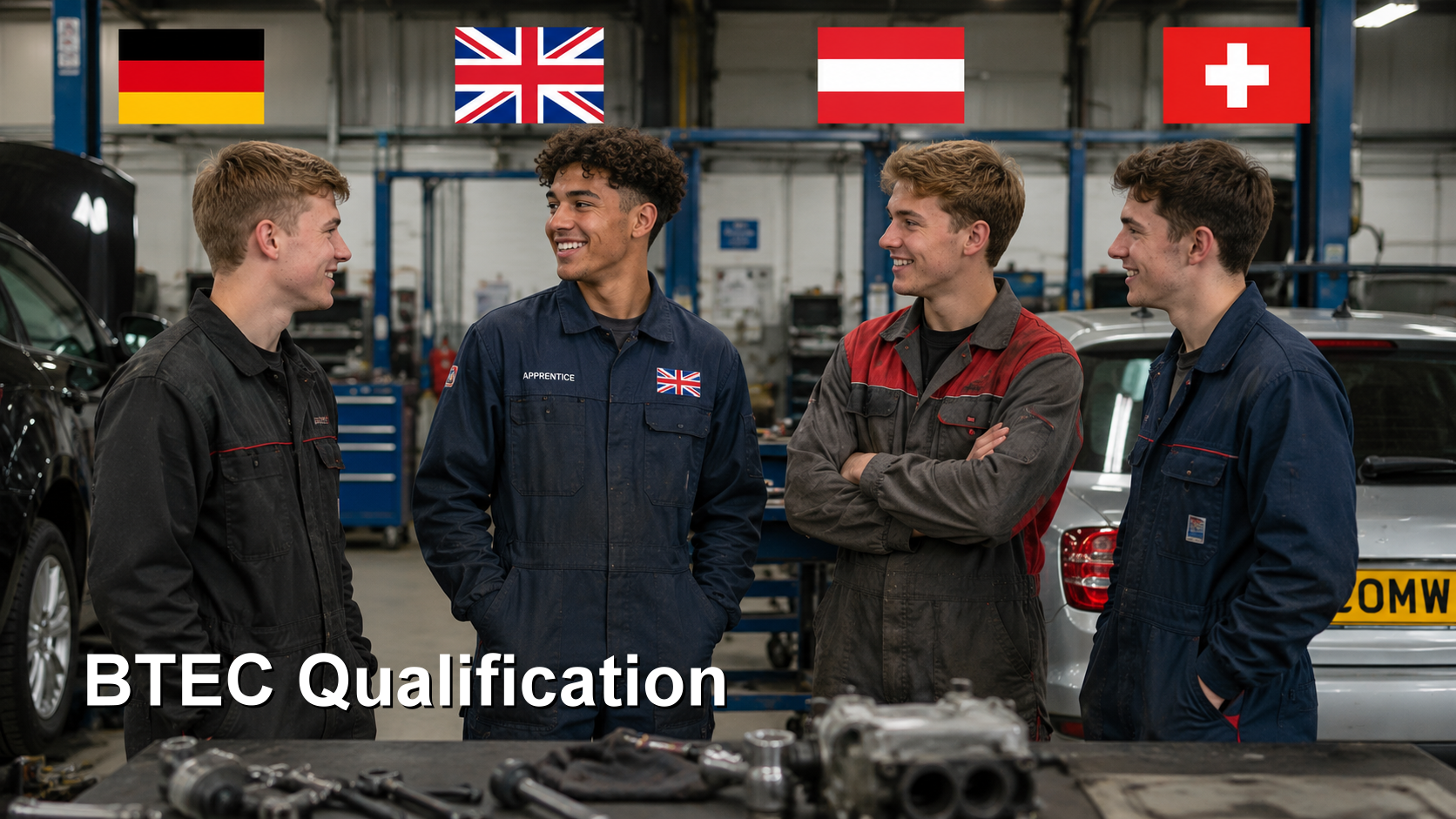
⚙️ BTEC Qualifications
More vocational and practical than A-Levels.
Popular areas include:
- Business
- Engineering
- Health and Social Care
- Information Technology
- Construction
.
T-Levels
Introduced in England in 2020.
These combine:
- Classroom learning
- Industry placements
- Practical training
T-Levels are designed as an alternative to A-Levels.
.
UK Qualification Framework
The UK uses qualification levels.
| UK Level | Qualification |
| Entry Level | Basic Skills |
| Level 1 | GCSE Grade 1-3 |
| Level 2 | GCSE Grade 4-9 |
| Level 3 | A-Level, T-Level, BTEC |
| Level 4 | Higher National Certificate (HNC) |
| Level 5 | Higher National Diploma (HND) |
| Level 6 | Bachelor’s Degree |
| Level 7 | Master’s Degree |
| Level 8 | Doctorate (PhD) |
.
🇩🇪 Comparing UK Qualifications with Germany
Germany uses a different educational structure.
GCSE Equivalent
Germany
Mittlerer Schulabschluss (Realschulabschluss)
Obtained after approximately 10 years of schooling.
Comparable to:
- GCSEs at Grades 4-9
.
🎓 A-Level Equivalent
Germany
Abitur
The Abitur allows entry to universities.
Comparable to:
- UK A-Levels
The Abitur generally covers more subjects than A-Levels.
.
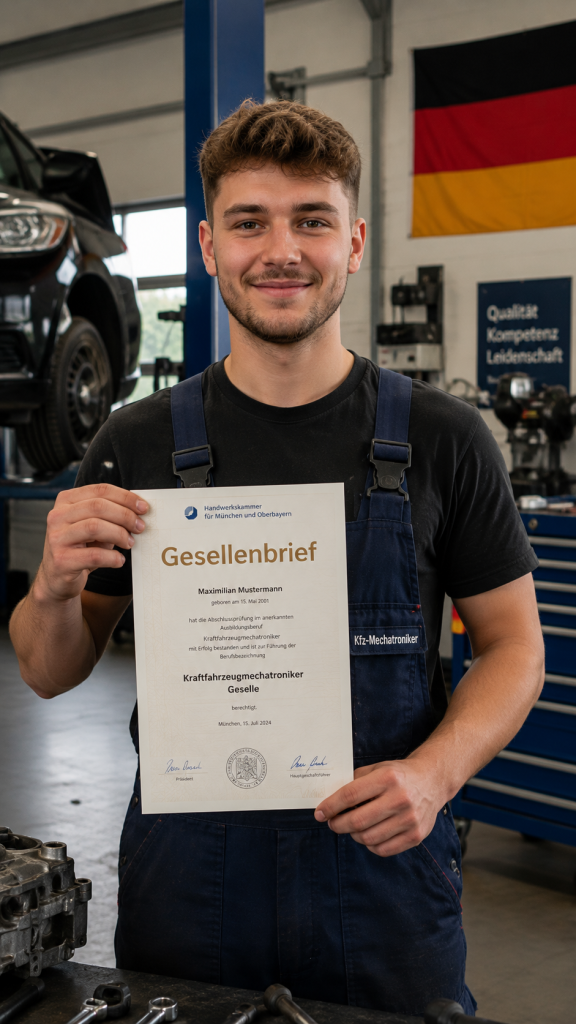
⚙️ Vocational Equivalent
Germany
Berufsausbildung
Germany’s famous apprenticeship system combines:
- Practical work
- Vocational school
Comparable to:
- UK Apprenticeships
- BTEC qualifications
- Some T-Levels
.
🇦🇹 Comparing UK Qualifications with Austria
Austria’s educational system has several comparable qualifications.
GCSE Equivalent
Austria
Mittlere Reife
or
Abschluss einer Mittelschule
Comparable to:
- GCSE Level qualifications
.
🎓 A-Level Equivalent
Austria
Matura
The Matura is required for university admission.
Comparable to:
- UK A-Levels
- German Abitur
.
⚙️ Vocational Equivalent
Austria
Lehre (Apprenticeship)
Combines:
- Workplace training
- Vocational schooling
Similar to:
- UK Apprenticeships
- BTEC pathways
.
🇨🇭 Comparing UK Qualifications with Switzerland
Switzerland’s system differs by canton but follows similar principles.
GCSE Equivalent
Switzerland
Sekundarschule Abschluss
Comparable to:
- GCSE qualifications
.
🎓 A-Level Equivalent
Switzerland
Gymnasiale Maturität
The Swiss Matura provides access to universities.
Comparable to:
- A-Levels
- German Abitur
- Austrian Matura
.
⚙️ Vocational Equivalent
Switzerland
Eidgenössisches Fähigkeitszeugnis (EFZ)
Federal vocational certificate.
Comparable to:
- UK Apprenticeships
- BTEC qualifications
- Technical qualifications
.
Degree Comparisons
Bachelor’s Degree
| United Kingdom | Germany | Austria | Switzerland |
| Bachelor (BA/BSc) | Bachelor | Bachelor | Bachelor |
All are generally equivalent under the Bologna Process.
.
Master’s Degree
| United Kingdom | Germany | Austria | Switzerland |
| Master’s Degree | Master | Master | Master |
Generally recognised as equivalent.
.
Doctorate
| United Kingdom | Germany | Austria | Switzerland |
| PhD | Doktor | Doktor | Doktor |
Equivalent doctoral-level qualifications.
.
Qualification Equivalence Overview
| United Kingdom | Germany | Austria | Switzerland |
| GCSE Grades 4-9 | Realschulabschluss | Mittlere Reife | Sekundarschule |
| A-Levels | Abitur | Matura | Maturität |
| Apprenticeship | Berufsausbildung | Lehre | EFZ |
| Bachelor’s Degree | Bachelor | Bachelor | Bachelor |
| Master’s Degree | Master | Master | Master |
| PhD | Doktor | Doktor | Doktor |
.
What Employers Usually Look For
For many UK jobs employers ask for:
Entry-Level Jobs
- GCSE English Grade 4+
- GCSE Mathematics Grade 4+
Skilled Jobs
- GCSEs plus vocational qualifications
- Apprenticeship certificates
- BTEC qualifications
Professional Jobs
- A-Levels
- Bachelor’s Degree
- Professional qualifications
.
Recognition of Foreign Qualifications
Foreign qualifications from Germany, Austria and Switzerland are generally recognised in the UK.
For official comparisons, employers and universities often refer to evaluations provided through the UK’s qualification recognition services.
This is particularly important for:
- Teaching
- Nursing
- Engineering
- Healthcare professions
- Government employment
.
Final Thoughts
Although the names differ, educational qualifications across the UK, Germany, Austria and Switzerland are generally comparable. GCSEs correspond broadly to lower secondary school qualifications, while A-Levels are comparable to the German Abitur, Austrian Matura and Swiss Maturität.
Understanding these equivalencies can help students, job seekers and employers navigate international applications more confidently and ensure qualifications are properly recognised across borders.