

CCTV, ANPR, Workplace Cameras and Vehicle Tracking: Is Britain Really Watching You Everywhere?
For people arriving in the United Kingdom from Germany, Austria or Switzerland, one aspect of everyday life can be particularly noticeable:
There are cameras everywhere.
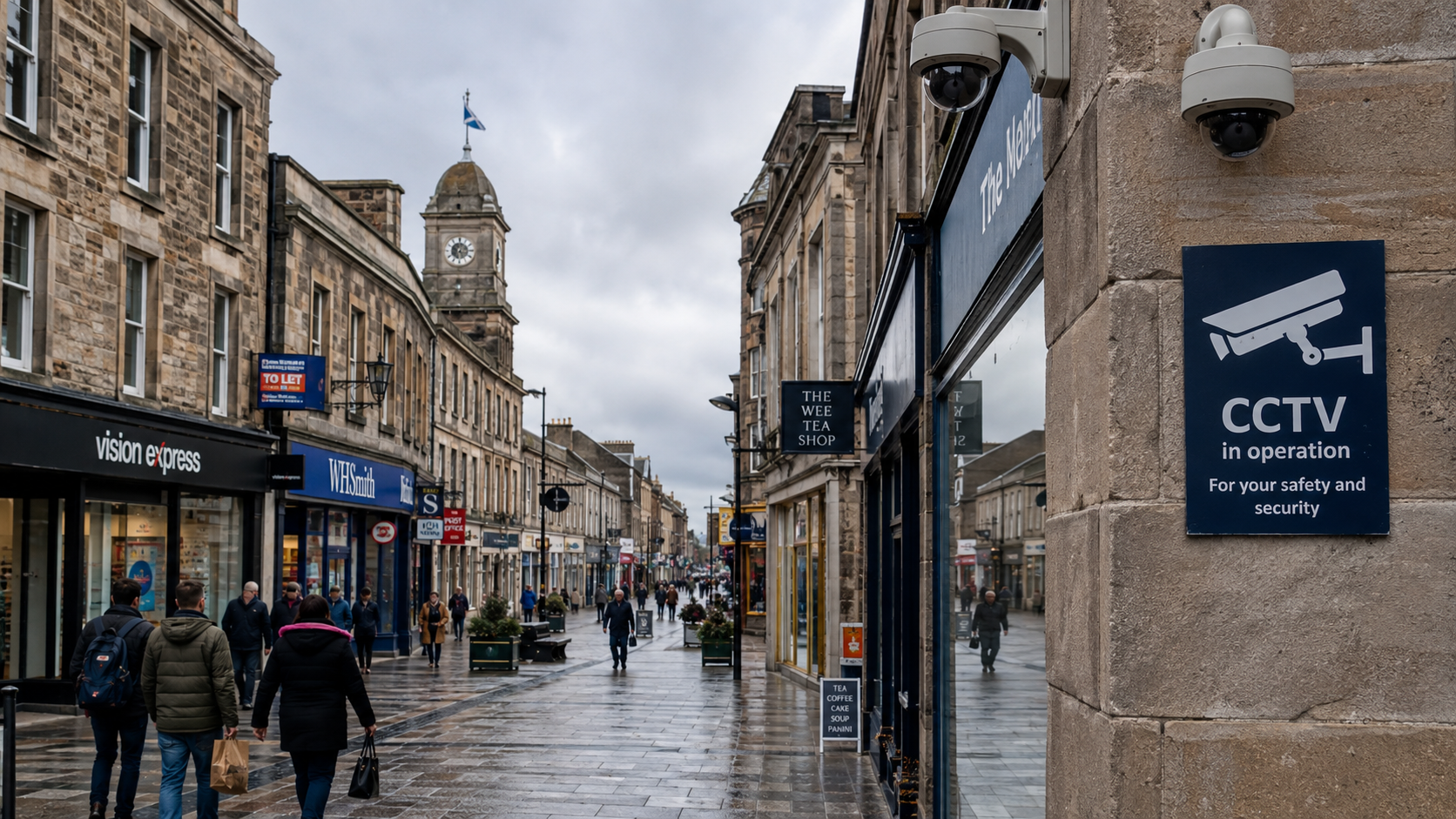
Walk through a British town centre and you’ll encounter CCTV. Drive into a supermarket car park and your registration number may be recorded automatically. Travel along major roads and you’ll encounter ANPR systems. Drive a company van and the employer may know where the vehicle is, how it is being driven and, increasingly, have cameras recording both outside and sometimes inside it.
Britain certainly has an extensive surveillance culture, but that doesn’t mean organisations can simply record whatever they want.
Behind the cameras sits a substantial framework of privacy and data-protection law.
So what can actually be monitored, what can’t, and how does Britain compare with Germany, Austria and Switzerland?
.
🇬🇧 Welcome to the Land of CCTV
CCTV has become an ordinary feature of British life.
You’ll find cameras around:
- Supermarkets
- Shopping centres
- Railway stations
- Petrol stations
- Car parks
- Warehouses
- Pubs
- Schools
- Hospitals
- Industrial estates
- Offices
- Town centres
- Public transport
- Residential properties
Their purposes vary enormously.
Some deter theft. Others protect staff, investigate accidents, control access or protect buildings.
Under UK data-protection law, however, identifiable images and information such as vehicle registration numbers can constitute personal data. Organisations using surveillance therefore have obligations under the UK GDPR and Data Protection Act 2018.
.
CCTV Does Not Mean “Anything Goes”
An employer or business cannot justify a camera simply by saying:
“We own the building.”
There must be a legitimate purpose for the surveillance, and the organisation needs to consider whether the monitoring is necessary and proportionate.
The Information Commissioner’s Office, or ICO, specifically warns that just because monitoring technology is available doesn’t mean using it is justified. Employers should use the least intrusive means capable of achieving their objective.
That distinction becomes extremely important at work.
.
📹 Cameras in the Workplace
A British employer can potentially operate CCTV in workplaces.
For example, cameras might protect:
🏭 Machinery
📦 Stock
🚪 Entrances
💷 Cash-handling areas
🚚 Loading bays
🚗 Company vehicles
👷 Staff working in higher-risk environments
But there should be a defined reason for doing it.
Workers should normally be told what monitoring takes place, what information is collected and why. High-risk monitoring may require a Data Protection Impact Assessment (DPIA).
.
Can Your Boss Watch You Working?
Potentially, but there is a huge difference between a camera that happens to capture employees and a surveillance system specifically designed to scrutinise every movement of individual employees.
Imagine a warehouse.
A camera overlooking a loading bay might be justified for:
security + health and safety + investigation of accidents.
A camera pointing continuously at one employee’s workstation merely so a manager can watch whether that person is working is considerably harder to justify.
The ICO explicitly stresses fairness, necessity and proportionality in employee monitoring.
.
🚫 Toilets, Changing Rooms and Private Areas
This is where the privacy boundary becomes much stronger.
Workers have an obvious and very high expectation of privacy in places such as:
🚽 Toilets
🚿 Bathrooms
👕 Changing areas
Covert video or audio monitoring should not be used in areas where workers reasonably expect privacy, such as toilets and changing rooms. The ICO gives the example of suspected theft from staff changing rooms and says monitoring the entrance outside the changing room is a more proportionate solution than filming workers inside.
So the simple rule is:
Security camera outside the toilet area? Potentially legitimate.
Camera inside the toilet? Absolutely different territory.
.
What About Secret Cameras?
Covert workplace surveillance is an exceptional measure rather than something an employer should routinely use.
Where it is justified for investigating suspected wrongdoing, the ICO says it should be targeted, limited to the shortest necessary period, restricted to relevant people and stopped once the investigation is finished.
Installing hidden cameras simply to see whether employees are working hard enough is another matter entirely.
.
🚗 Company Vehicles Know Where You Are
This is an area where British workers increasingly encounter monitoring.
Modern commercial fleets can use telematics systems recording things such as:
📍 GPS position
🚗 Vehicle speed
🛑 Braking
⚡ Acceleration
⏱ Journey duration
🛣 Routes
⛽ Fuel consumption
🚐 Vehicle utilisation
For fleet operators, there are legitimate reasons.
A company with 500 vans may need to know where vehicles are so it can dispatch the nearest engineer, recover stolen vehicles, plan routes, manage fuel consumption or investigate accidents.
But once the data can identify the driver, it becomes personal information.
The ICO explicitly states that telematics information recording drivers’ activities is subject to data-protection law.
.
Can My Employer Track My Van All Day?
During work, potentially yes, provided there is an appropriate lawful basis and the monitoring is necessary, proportionate and transparent.
But what happens at 5 pm?
That’s where things become interesting.
If employees are permitted to use company vehicles privately, the ICO says employers will rarely be able to justify monitoring during private use.
It even gives the example of company vehicles whose tracking can be disabled when employees aren’t working.
In other words:
Company van during working hours: tracking may be justified.
Company car on your private Sunday trip: much harder to justify.
.
🎥 And Now There Are Cameras in the Van
GPS isn’t the end of it.
Commercial vehicles increasingly contain:
- Forward-facing dashcams
- Rear cameras
- Side cameras
- Load-area cameras
- Driver-facing cameras
- GPS
- Telematics
- Collision sensors
A fleet vehicle can therefore become a little data centre on wheels.
Vehicle surveillance may have genuine safety and security purposes, but employers must still consider the privacy implications for drivers, passengers, pedestrians and other motorists.
The ICO notes that inward-facing cameras are particularly intrusive because they record drivers and passengers. Audio creates even greater privacy concerns and should generally be switched off by default, with exceptional activation where genuinely necessary.
Workers and passengers must also receive appropriate information about vehicle monitoring.
.
🚘 ANPR: The Camera That Reads Your Number Plate
Then we arrive at one of Britain’s most visible surveillance technologies:
ANPR
Automatic Number Plate Recognition
ANPR cameras automatically detect and read vehicle registration plates.
The ICO specifically treats registration information captured by ANPR as information capable of relating to identifiable people and therefore within the scope of data-protection rules.
.
Where Is ANPR Used?
ANPR can be encountered around:
- Roads
- Police systems
- Airports
- Car parks
- Shopping centres
- Petrol stations
- Private parking facilities
- Industrial sites
- Restricted areas
A camera captures the registration and software converts the plate into searchable data.
Instead of somebody manually reading:
AB12 CDE
the computer does it automatically.
That registration can then potentially be matched against other relevant information depending on who operates the system and its lawful purpose.
.
Private Parking and ANPR
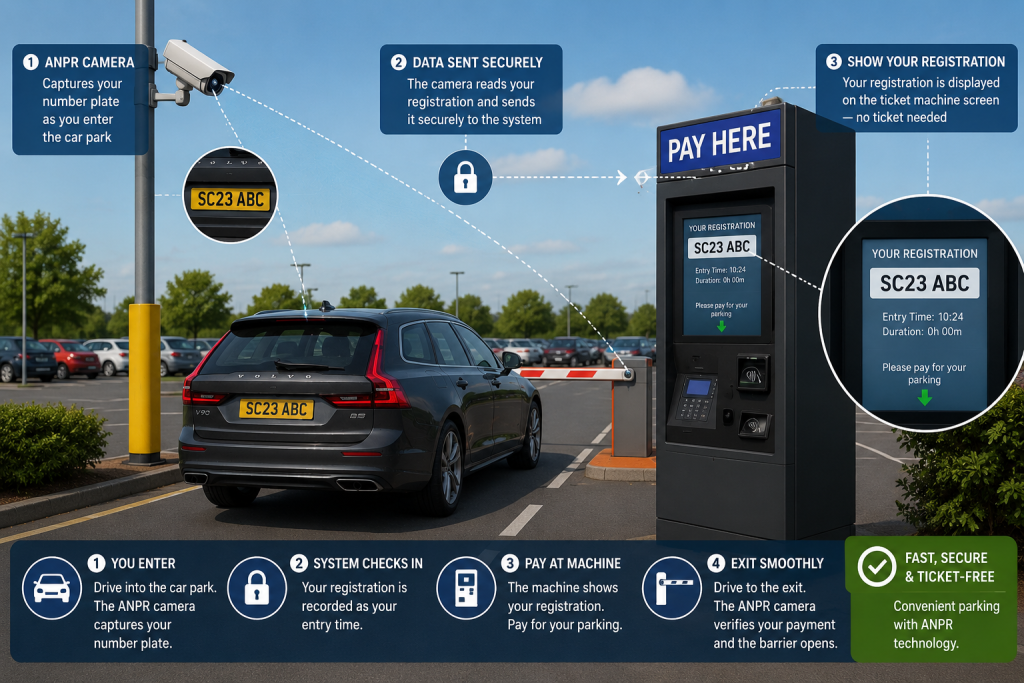
One of the most familiar examples is the supermarket car park.
You drive in at:
10:03
The ANPR system records your registration.
You leave at:
11:17
It records the registration again.
The parking system can calculate:
1 hour 14 minutes
No paper ticket is required.
This is extremely convenient for parking management, although anyone who has received a parking charge after overstaying by a few minutes may have less affectionate terminology for it.
.
👮 Police ANPR
Police ANPR is considerably more sophisticated than the average supermarket car park.
It can assist law enforcement in identifying vehicles of interest and investigating crime.
But police surveillance and law-enforcement processing operate under additional legal frameworks. The ICO notes that covert surveillance by public authorities can also fall under legislation such as the Regulation of Investigatory Powers Act and, in Scotland, the Regulation of Investigatory Powers (Scotland) Act.
.
CCTV + ANPR + GPS = A Lot of Data
The interesting part isn’t necessarily any individual system.
It’s what happens when technologies become interconnected.
The ICO specifically warns that combining surveillance information can increase privacy risks. Organisations need to ensure information remains accurate, isn’t excessive, is used only for defined purposes, and remains necessary and proportionate.
A single GPS coordinate doesn’t reveal much.
Thousands of coordinates over six months can reveal:
where somebody works, when they arrive, where they stop, which routes they use and patterns in their daily life.
That’s why location data deserves serious protection.
.
🇩🇪 How Is Germany Different?
Germany operates under the EU GDPR alongside its national data-protection framework, including the Bundesdatenschutzgesetz.
CCTV certainly exists in Germany. So do dashcams, GPS fleet management and number-plate recognition.
The cultural and regulatory approach to employee surveillance, however, is generally more privacy-sensitive.
German data-protection authorities stress the imbalance of power between employer and employee when considering workplace camera surveillance. An employee’s apparent “consent” isn’t automatically regarded as genuinely voluntary simply because they signed something their employer presented to them.
That makes permanent monitoring of individual employees particularly difficult to justify.
.
🇦🇹 Austria Goes Even Further in Some Areas
Austria provides a particularly interesting comparison.
The Austrian Data Protection Authority states that workplace video surveillance for the purpose of controlling employees is unlawful.
Cameras may nevertheless be permissible for legitimate purposes such as protecting property from theft or vandalism, but organisations should consider whether cameras could operate outside working hours or be positioned so employees aren’t continuously captured.
Areas such as:
- Break rooms
- Kitchens
- Changing rooms
- Access to toilets
receive particularly strong protection during working hours.
.
Austrian GPS Tracking
Austria is similarly cautious about employee GPS monitoring.
Continuous location tracking of a company vehicle can produce an almost complete movement profile of an employee. Austrian employment guidance therefore treats such tracking as a significant interference with personal privacy and says less intrusive alternatives should be considered.
Austria’s Data Protection Authority also confirms that GPS tracking will generally involve personal data when the operator can identify who or what is being tracked, requiring a balancing of legitimate interests and the rights of the affected person.
.
🇨🇭 Switzerland
Switzerland isn’t part of the EU and therefore has its own system, particularly the Federal Act on Data Protection (FADP) and employment legislation.
Its approach to workplace surveillance is remarkably strict.
The Swiss Federal Data Protection and Information Commissioner states that monitoring systems intended to monitor employees’ behaviour are prohibited.
Where surveillance is genuinely required for another reason, such as safety, production or security, it must be organised so employees aren’t subjected to constant behavioural surveillance.
Swiss guidance also emphasises:
- Proportionality
- Transparency
- Good faith
- Employee personality rights
- Health and wellbeing
Continuous monitoring can itself become problematic because of the psychological pressure it places on workers.
.
🇬🇧 🇩🇪 🇦🇹 🇨🇭 Quick Comparison
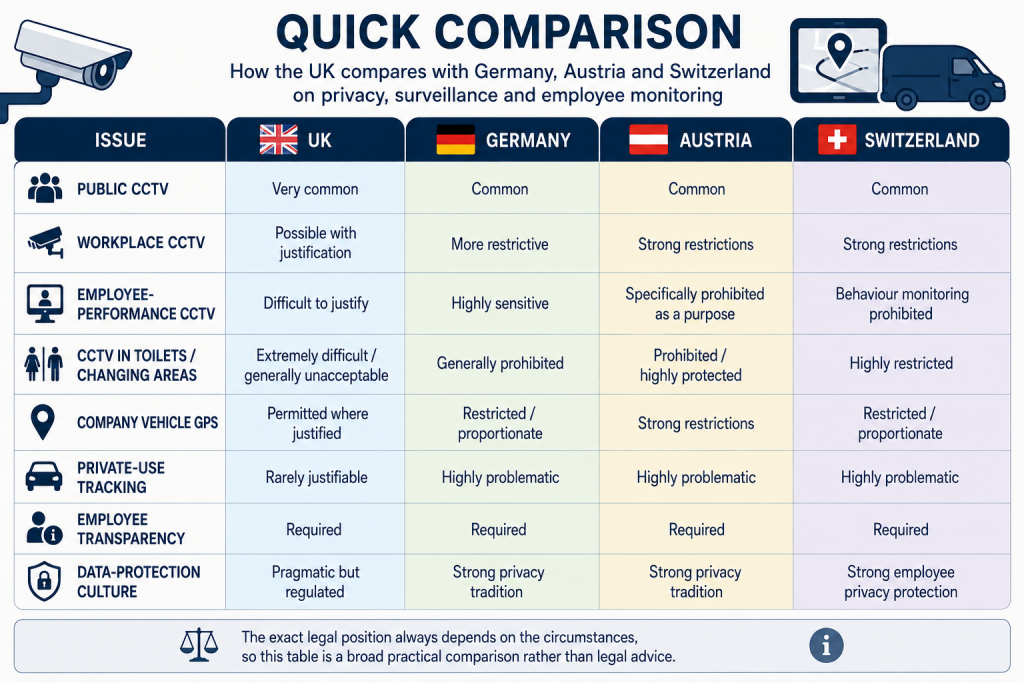
The exact legal position always depends on the circumstances, so this table is a broad practical comparison rather than legal advice.
.
.
Is Privacy Weaker in Britain?
That’s actually a more complicated question than it first appears.
From a visitor’s perspective, Britain can feel more heavily monitored because cameras are extremely visible.
But visibility isn’t the same thing as absence of privacy law.
The UK has extensive rules governing personal data, surveillance and workplace monitoring. Employers have to identify lawful grounds, consider proportionality, provide information and, where risks are sufficiently high, conduct impact assessments.
The biggest difference is often cultural.
Britain tends to accept CCTV as an ordinary security tool more readily than Germany, Austria or Switzerland.
.
The Strange Privacy Paradox
And this produces an amusing contradiction.
As we discussed with British houses, you can live in a home where:
your bedroom door doesn’t even have a lock.
Then you leave the house.
Your neighbour’s doorbell camera sees you.
The supermarket CCTV sees you.
The car park reads your registration.
The company van records its GPS position.
The dashcam records the road.
The warehouse CCTV records your arrival.
And somewhere, a computer quietly records another timestamp.
Britain can therefore simultaneously feel extremely relaxed about physical privacy inside the family home and remarkably comfortable with technological surveillance outside it.
It’s a fascinating cultural contrast.
.
What Rights Do Employees Have?
If your employer monitors you, you shouldn’t simply have to guess what’s happening.
Workers should be informed about what personal information is collected, how and why monitoring occurs. The ICO also confirms that workers may have rights to access personal information obtained through monitoring.
Questions worth asking include:
What is being recorded?
Why is it necessary?
Who can access it?
How long is it retained?
Is GPS active outside working hours?
Does an in-cab camera record continuously?
Is audio being recorded?
Those questions can turn an invisible surveillance system into something considerably more transparent.
.
Final Thoughts
Britain is undoubtedly comfortable with surveillance technology.
CCTV, ANPR, dashcams, vehicle telematics and GPS fleet tracking have become deeply embedded in everyday life. They can improve security, investigate accidents, protect employees, manage fleets and help police identify vehicles of interest.
But having the technology doesn’t automatically create the right to use it however an organisation wishes.
The central principles remain necessity, proportionality, transparency and lawful processing.
Germany, Austria and Switzerland generally approach workplace surveillance with an even stronger emphasis on employee privacy, particularly where monitoring could become continuous behavioural or performance control. Austria expressly prohibits video surveillance for employee-control purposes, while Switzerland prohibits systems aimed at monitoring employee behaviour.
So yes, when moving from continental Europe to Britain, you may initially feel that you’ve suddenly wandered onto the set of a television programme called CCTV: The Nation.
But behind those cameras is an important distinction:
Being recorded can be lawful. Being watched without limits is not.
For current UK guidance, the Information Commissioner’s Office guidance on monitoring workers is an excellent starting point.
I like this