


Understanding the Scottish Tax System: A Guide for Immigrants Moving to Scotland
One of the biggest adjustments when moving to Scotland is understanding how income tax works. Unlike Germany, Austria or Switzerland, most employees never file a regular tax return because tax is usually deducted automatically from their salary. However, Scotland has its own income tax rates, while the UK Government still controls National Insurance and several other taxes.
This guide explains how the Scottish tax system works, the role of HM Revenue & Customs (HMRC), what happens when you start your first job and what you need to know as a newcomer.
.
Who Collects Taxes?
Taxes across the United Kingdom are administered by HM Revenue & Customs (HMRC).
HMRC is responsible for:
- Collecting Income Tax
- Collecting National Insurance
- VAT (Value Added Tax)
- Corporation Tax
- Capital Gains Tax
- Inheritance Tax
- Child Benefit administration
- Tax refunds
- Self Assessment tax returns
Although Scotland has different Income Tax rates, HMRC still administers the system.
.
Does Scotland Have Its Own Tax System?
Partly.
The Scottish Parliament sets:
- Scottish Income Tax rates
- Scottish Income Tax bands
The UK Government still controls:
- National Insurance
- VAT
- Corporation Tax
- Capital Gains Tax
- Inheritance Tax
So if you live in Scotland, your Income Tax may differ from someone earning the same salary in England.
.
What Is PAYE?
Most employees are taxed using the PAYE (Pay As You Earn) system.
This means:
- Your employer calculates your tax.
- Income Tax is deducted automatically.
- National Insurance is deducted automatically.
- Pension contributions (if applicable) are deducted automatically.
- You receive your salary after deductions.
Unlike Germany or Austria, many UK employees never need to submit an annual tax return.
.
Your First Job in Scotland
When you start work, your employer will usually ask for:
- Passport or immigration documents
- National Insurance Number (if you have one)
- P45 (if you previously worked in the UK)
- Starter Checklist (if you are new to the UK)
HMRC then allocates your tax code.
What Is a Tax Code?
A tax code tells your employer how much tax-free income you are entitled to before Income Tax is deducted.
A common example is:
S1257L
Breaking it down:
- S = Scottish taxpayer
- 1257 = Personal Allowance (£12,570 under current rules)
- L = Standard tax code
If your code starts with S, Scottish Income Tax rates apply.
There isn’t a fixed number of Scottish tax codes because HMRC can create thousands of individual tax codes by combining numbers (personal allowances or adjustments) with letters and prefixes. However, there are only a relatively small number of standard Scottish code types that most people will ever encounter.
The most common Scottish tax codes
All Scottish taxpayer codes begin with the letter S, which tells your employer to apply Scottish Income Tax rates.
| Scottish Tax Code | Meaning | Typical use |
|---|---|---|
| S1257L | Standard Personal Allowance | Most employees |
| S1263L, S1285L, etc. | Increased Personal Allowance | Uniform allowance, tax reliefs |
| SKxxx | Negative allowance | Taxable benefits or tax owed |
| SBR | Scottish Basic Rate | Second job or second pension |
| SD0 | Scottish Intermediate Rate | Second income taxed entirely at the intermediate rate |
| SD1 | Scottish Higher Rate | Second job for higher-rate taxpayers |
| SD2 | Scottish Top Rate | Very high earners on additional income |
| S0T | No Personal Allowance | Temporary or high-income situations |
| SD0 W1/M1 | Emergency code | New job without complete tax information |
| S1257L W1/M1 | Emergency code with standard allowance | Common when starting a new job |
.
The letters explained
The number represents your tax-free Personal Allowance (usually multiplied by 10):
- 1257 = £12,570 tax-free
- 1263 = £12,630 tax-free
- 1100 = £11,000 tax-free
.
The letter indicates how HMRC wants the allowance applied:
- L = Standard allowance
- M = Marriage Allowance received
- N = Marriage Allowance transferred to spouse
- T = HMRC review required
- K = Taxable benefits exceed your allowance
- BR = Basic rate only
- D0 = Intermediate rate only (Scottish code: SD0)
- D1 = Higher rate only (Scottish code: SD1)
- D2 = Top rate only (Scottish code: SD2)
- 0T = No Personal Allowance
- NT = No tax deducted (rare and generally not used with Scottish-prefixed PAYE codes)
.
How many are there in total?
In practice:
- Around 10 to 15 common code types cover almost all Scottish employees.
- HMRC can generate thousands of unique tax codes by changing the numeric part to reflect individual circumstances, such as company benefits, underpaid tax, charitable deductions, or professional expenses.
For example, all of these are perfectly valid Scottish tax codes:
- S1257L
- S1263L
- S1312L
- S1100L
- SBR
- SD0
- SD1
- SD2
- S0T
- SK497
For your immigration website, it could be useful to include a table explaining every Scottish tax code, what it means, when you might receive it, and examples of who would typically have each one. That would make a practical follow-up article to your guide on the Scottish tax system.
.
Scottish Income Tax Bands
Scotland has more tax bands than the rest of the UK.
Typical bands include:
- Starter Rate
- Basic Rate
- Intermediate Rate
- Higher Rate
- Advanced Rate
- Top Rate
This creates a more progressive system where higher earners pay higher marginal rates.
Remember that tax bands can change each tax year, so always check the latest figures published by HMRC and the Scottish Government.
.
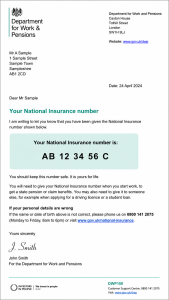
What Is National Insurance?
National Insurance (NI) is not Income Tax.
It helps fund:
- State Pension
- NHS
- Certain state benefits
- Maternity benefits
- Jobseeker support
Almost everyone who works and earns above the relevant threshold pays National Insurance contributions.
.
Do I Need a National Insurance Number?
Yes.
A National Insurance Number (NIN or NINo) is your personal tax and social security number.
It stays with you for life.
Your employer uses it to report:
- Earnings
- Tax
- National Insurance contributions
You usually receive one after moving to the UK if required for work, or you may already have one if you previously lived or worked in the UK.
.
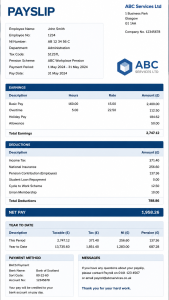
What Does My Payslip Show?
A typical Scottish payslip includes:
- Gross Pay
- Income Tax
- National Insurance
- Pension contributions
- Student loan deductions (if applicable)
- Net Pay (what reaches your bank account)
Always keep your payslips as proof of income.
Do I Have to Submit a Tax Return?
Most employees do not.
HMRC normally collects the correct tax automatically through PAYE.
You may need to complete a Self Assessment tax return if you:
- Are self-employed
- Own a business
- Receive significant rental income
- Have substantial investment income
- Earn above certain thresholds requiring additional reporting
- Have complex tax affairs
For many employees, PAYE means there is no annual paperwork.
.
Tax Refunds
Sometimes you pay too much tax.
This can happen if:
- You change jobs.
- You stop working during the tax year.
- Your tax code was incorrect.
- You worked only part of the year.
HMRC may automatically issue a refund, or you can claim one if necessary.
.
What If I Pay Too Little Tax?
Occasionally HMRC discovers that insufficient tax has been deducted.
Reasons may include:
- Incorrect tax code
- Multiple jobs
- Benefits in kind
- Employer reporting errors
HMRC will usually explain how any underpayment will be collected, often by adjusting your future tax code or requesting payment.
.
Pension Contributions
Many employers automatically enrol staff into a workplace pension.
This is known as Auto-Enrolment.
Typically:
- You contribute a percentage of your salary.
- Your employer also contributes.
- The Government provides tax relief on eligible contributions.
You can usually opt out if you wish, although staying enrolled is often beneficial for long-term retirement savings.
.
Self-Employment
If you become self-employed:
- You must register with HMRC.
- Keep records of your income and expenses.
- Submit a Self Assessment tax return.
- Pay Income Tax and National Insurance based on your profits.
Many freelancers use an accountant to help with their tax affairs.
.
How Does Scotland Compare with Germany, Austria and Switzerland?
🏴 Scotland
Advantages
➕ PAYE handles most taxes automatically.
➕ Most employees never need to file a tax return.
➕Simple payroll deductions.
➕ Personal tax account available online.
Disadvantages
➖ Scottish tax bands can be confusing for newcomers.
➖ Different rules from England can cause confusion.
.
🇩🇪 Germany
Advantages
➕ Extensive tax allowances.
➕ Joint taxation available for married couples in many cases.
➕ Well-established social insurance system.
Disadvantages
➖ Annual tax returns are common.
➖ More complex tax classes.
➖ Extensive paperwork.
.
🇦🇹 Austria
Advantages
➕ Efficient electronic tax system (FinanzOnline).
➕ Strong social security coverage.
Disadvantages
➖ Higher payroll deductions for many employees.
➖ More administrative processes.
.
🇨🇭 Switzerland
Advantages
➕ Generally lower Income Tax rates in many cantons.
➕ Local control over taxation.
Disadvantages
➖ Tax systems differ between cantons.
➖ Residents often submit annual tax returns.
.
Tips for New Immigrants
- Apply for your National Insurance Number if needed.
- Check your tax code on your first payslip.
- Keep every payslip and P60.
- Inform HMRC if your address changes.
- Register for a Personal Tax Account to view your tax information online.
- Tell HMRC if you start self-employment or have other taxable income.
.
Common Tax Documents
You may receive several important documents during the year.
P45
Issued when leaving a job.
P60
Summary of your pay and tax for the tax year.
P11D
Shows certain taxable benefits provided by your employer.
Keep these documents in a safe place, as they are often needed for mortgage applications, visa renewals or proving your income.
.
Final Thoughts
The Scottish tax system may initially seem unfamiliar, particularly if you are used to filing annual tax returns in Germany, Austria or Switzerland. However, most employees in Scotland benefit from the simplicity of the PAYE system, where tax and National Insurance are deducted automatically before your salary reaches your bank account.
Understanding your tax code, National Insurance contributions and payslip will help you manage your finances with confidence. While Scotland has its own Income Tax rates, HMRC administers the system, making it straightforward for most employees once they have settled into work.
Every day is a new beginning
Hahahaha You are so good
a good blog
toper
Interesting…
Great post,Thanks for sharing
Hi~(* ̄▽ ̄*)
Honestly, it’s really good
So,I like it