


How Medical Care Compares with Germany, Austria and Switzerland
Moving to the United Kingdom often means adapting to a different healthcare system. One of the biggest surprises for newcomers from Germany, Austria and Switzerland is the role of the General Practitioner (GP), who acts as the gateway to most NHS healthcare services. GP’s are normally to find in a GP Practise which is comparable to a house of different GP’s and specialist nurses. It is more like a Ärztehaus (medical clinic). Also keeo
This guide explains how GP appointments work in the UK, typical waiting times, and how the British system compares with the “Hausarzt” model found in German-speaking countries.
.
What Is a GP?
A GP (General Practitioner) is the UK’s equivalent of a family doctor or Hausarzt.
GPs provide:
- General medical consultations
- Diagnosis and treatment of common illnesses
- Prescriptions
- Sick notes for employers
- Vaccinations
- Preventive healthcare
- Referrals to specialists
- Management of chronic conditions
For most non-emergency medical problems, your GP is the first point of contact.
.
Registering with a GP Practice
Unlike Germany, Austria and Switzerland, you cannot usually visit any GP you choose.
You normally:
- Find a local GP practice, they often operate within post code areas, they can overlap but mostly they have a certain area assigned and you must go to this GP Practise if you live within the designated area
- Register as a patient
- Become assigned to that practice
Registration generally requires:
- Proof of identity
- Address confirmation
- NHS number (if available)
Registration itself is free.
.

How GP Appointments Work
Most GP practices offer:
Telephone Appointments
Many consultations now begin with a phone call from a doctor or nurse.
The GP may:
- Resolve the issue over the phone
- Prescribe medication
- Arrange tests
- Invite you for a face-to-face appointment
.
Face-to-Face Appointments
You attend the surgery in person.
Common reasons include:
- Physical examinations
- Persistent symptoms
- Chronic disease reviews
- Mental health support
.
Online Consultations
Many surgeries now offer:
- Online forms
- Video consultations
- Digital triage systems
.
Typical Waiting Times in the UK
Waiting times vary considerably.
Urgent Problems
Often:
- Same day
- Within 24 to 48 hours
.
Routine GP Appointments
Often:
- Several days
- One to three weeks
Depending on the practice and region.
.
Specialist Referrals
This is where waiting times can become significantly longer.
Routine Referral
Often:
- Several weeks
- Several months
.
Non-Urgent Surgery
May involve waits of:
- Months
- Occasionally over a year
depending on speciality and region.
.
What Happens if It Is an Emergency?
For emergencies, patients should use:

Life-threatening emergencies.
Examples:
- Heart attack
- Stroke
- Serious injuries
.
A&E (Accident & Emergency)
Hospital emergency departments. If the person is NOT breathing or NOT able of walking call 999 and request an ambulance.
.
NHS 111
For urgent medical advice when unsure where to go.

Available 24 hours a day.
The NHS 111 service is also available online by visiting 111.nhs.uk
.
How Does This Compare with Germany?
Germany uses a different approach.
Freedom of Choice
German patients can usually:
- Choose their own Hausarzt
- Change doctors easily
- Visit specialists directly in many cases
This gives patients greater flexibility.
.
Specialist Access
Many patients can arrange appointments directly with:
- Orthopaedic specialists
- Dermatologists
- ENT specialists
- Cardiologists
without requiring a referral.
.

Waiting Times
Generally shorter than the UK for:
- Specialist consultations
- Diagnostic imaging
- Elective procedures
although regional differences exist.
.
How Does Austria Compare?
Austria’s healthcare system is similar to Germany’s.
Patients can usually:
- Choose their doctor
- Access specialists more easily
- Obtain appointments relatively quickly
Many Austrian doctors operate in both:
- Public insurance systems
- Private systems
This often reduces waiting times.
.
How Does Switzerland Compare?
Switzerland combines public regulation with private health insurance.
Patients generally enjoy:
- Excellent access to specialists
- Short waiting times
- Modern facilities
However, healthcare costs are significantly higher than in the UK.
Patients pay:
- Monthly insurance premiums
- Deductibles
- Co-payments
.
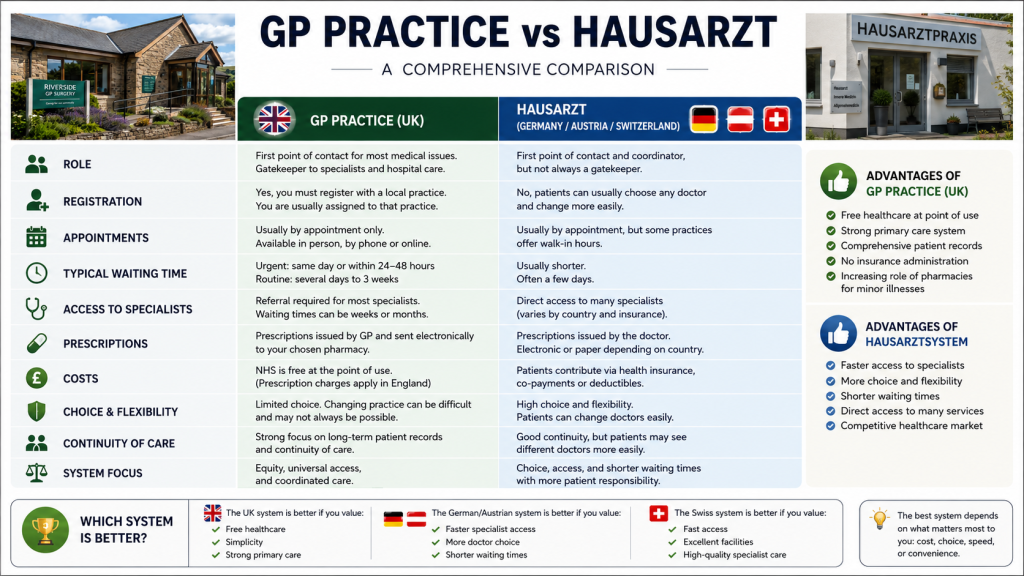
GP Practice vs Hausarzt
.
Advantages of the UK System
Completely Free Healthcare
Most NHS services are free at the point of use.
You generally do not receive bills for:
- GP appointments
- Hospital treatment
- Emergency care
- Specialist consultations
.
Strong Primary Care
GPs coordinate patient care and maintain complete medical records.
This can improve:
- Continuity of care
- Long-term disease management
.
No Insurance Administration
Patients do not need to:
- Compare insurance providers
- Pay monthly health premiums
- Manage reimbursement claims
.
Disadvantages of the UK System
Waiting Times
The most common criticism.
Particularly for:
- Specialist referrals
- Elective procedures
- Non-urgent diagnostics
.
Limited Choice
Patients are usually tied to local practices.
Changing doctors can be difficult.
.
Referral Gatekeeping
Many specialist services require GP approval. In rural areas often requires long travel distances to see the specialist.
Some patients find this frustrating.
.
Advantages of Germany, Austria and Switzerland
Faster Specialist Access
Patients often see specialists sooner.
.
More Patient Choice
Freedom to select:
- Doctors
- Specialists
- Clinics
.
Greater Competition
Competition between providers can improve service quality.
.
Disadvantages of Germany, Austria and Switzerland
Higher Costs
Patients contribute through:
- Insurance premiums
- Payroll deductions
- Co-payments
- Deductibles
.
More Administration
Insurance paperwork can be complex.
.
Unequal Access
Private insurance can sometimes provide faster access than public systems.
.
Which System Is Better?
There is no universally correct answer.
The UK NHS Is Better If You Value:
✅ Free healthcare
✅ Simplicity
✅ No insurance premiums
✅ Strong primary care
.
Germany and Austria Are Better If You Value:
✅ Faster access to specialists
✅ More doctor choice
✅ Shorter waiting times
✅ Greater flexibility
.
Switzerland Is Better If You Value:
✅ Fast access
✅ Excellent facilities
✅ High-quality specialist care
✅ Minimal waiting times
but only if you are comfortable paying substantially higher healthcare costs.
.
Final Thoughts
The NHS remains one of the world’s largest publicly funded healthcare systems and provides universal healthcare free at the point of use. For routine medical care, UK GPs offer comprehensive support and continuity of care.
However, compared with Germany, Austria and Switzerland, patients often face longer waiting times and more restrictions on direct specialist access.
For many people, the ideal system lies somewhere between the UK’s free NHS model and the greater flexibility offered by the healthcare systems of Germany, Austria and Switzerland. Each system has strengths and weaknesses, and the “best” choice often depends on whether affordability, speed of access or freedom of choice is most important to the individual patient.