


Understanding the Colours
Walk into any British supermarket and you’ll quickly notice something interesting in the dairy aisle. Although milk bottles from different supermarkets and brands may look completely different, one thing remains remarkably consistent: the colour of the cap.
Blue, green, red, orange, yellow… these colours aren’t just for decoration. They help shoppers instantly identify the type of milk inside without needing to read the label.
But where did this system come from, and why do different dairy products use different colours?
Let’s take a look at the fascinating history behind dairy colour coding.
.
Why Colour Coding Exists
Milk is one of the most frequently purchased grocery items in the UK.
Supermarkets wanted customers to be able to identify different varieties quickly, especially as self-service shopping became the norm during the 1960s and 1970s.
A simple colour system offered several advantages:
- Faster shopping
- Fewer purchasing mistakes
- Easy recognition across different brands
- Helpful for elderly customers and people with reduced vision
- Consistency regardless of supermarket
Although there is no law requiring specific colours, the industry gradually adopted common standards that are now recognised across the UK.
.
The Main Milk Colours
🔵 Blue – Whole Milk
Whole milk contains around 3.5–4% fat.
It is the least processed variety and retains most of its natural cream.
Typical uses include:
- Tea and coffee
- Breakfast cereals
- Cooking
- Baking
- Drinking
Blue has become the traditional colour associated with “full strength” milk.
.
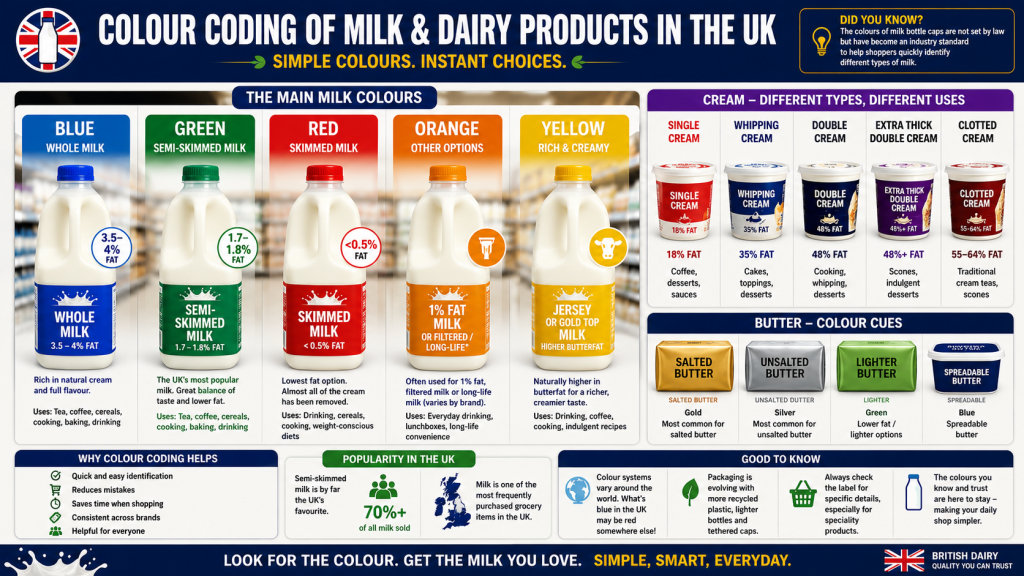
🟢 Green – Semi-Skimmed Milk
Semi-skimmed milk contains approximately 1.7–1.8% fat.
This is by far the UK’s most popular milk.
It provides much of the flavour of whole milk while containing significantly less fat.
Green was chosen to represent the “middle” option between whole and skimmed milk.
.
🔴 Red – Skimmed Milk
Skimmed milk contains less than 0.5% fat.
Almost all of the cream has been removed, making it the lowest-fat option.
It remains rich in calcium and protein while being very low in calories.
Red helps distinguish it clearly from the richer varieties.
.
Other Milk Colours
As more specialised products entered the market, additional colours became common.
🟠 Orange
Often used for:
- 1% milk
- Filtered milk
- Long-life milk (varies by manufacturer)
There is no universal rule, so it’s always worth checking the label.
🟡 Yellow
Commonly used for:
- Jersey milk
- Gold-top milk
- Extra creamy milk
These milks contain naturally higher butterfat and have a richer flavour.
🟣 Purple
Sometimes seen on:
- Lactose-free milk
- Special dietary milk
Again, this depends on the manufacturer.
.
Why Aren’t These Colours Required by Law?
Interestingly, UK legislation does not prescribe cap colours for milk.
Instead, manufacturers voluntarily adopted a common system because consumers quickly became familiar with it.
Changing the colours now would likely confuse millions of shoppers.
This is an excellent example of an industry standard developing naturally rather than through regulation.
.
The Story of Cream
Cream products use a wider variety of packaging colours because there are many more types available.
Unlike milk, shoppers usually rely more on the product name than the lid colour.
The most common cream varieties include:
| Product | Typical Fat Content | Common Uses |
|---|---|---|
| Single Cream | 18% | Coffee, desserts, sauces |
| Whipping Cream | 35% | Cakes, desserts |
| Double Cream | 48% | Cooking, whipping, desserts |
| Extra Thick Double Cream | 48%+ | Scones, desserts |
| Clotted Cream | 55–64% | Afternoon tea, scones |
Different supermarkets may use different coloured lids, but premium products often feature:
- Gold
- Cream
- Dark blue
- Burgundy
to suggest richness and quality.
.
Butter Colour Coding
Butter packaging also follows familiar visual cues.
You’ll often find:
- Gold for salted butter
- Silver for unsalted butter
- Green for lighter or reduced-fat products
- Blue for spreadable butter
Again, these are conventions rather than legal requirements.
.
How Colour Coding Helps Shoppers
The UK’s dairy colour system has become so familiar that many shoppers identify products almost instantly.
Instead of reading every label, customers simply look for:
🔵 Blue = Whole
🟢 Green = Semi-skimmed
🔴 Red = Skimmed
This saves time, reduces mistakes and makes supermarket shopping much easier.
.
Is the System the Same Everywhere?
Not necessarily.
Different countries use completely different colour schemes.
For example:
- Germany often uses blue for low-fat milk and red for whole milk.
- France has its own regional variations.
- Scandinavian countries use different colour combinations again.
This can occasionally confuse visitors or people who have recently moved to the UK.
.
Interesting Facts
- Semi-skimmed milk accounts for the largest share of milk sales in the UK.
- Whole milk naturally contains around twice as much fat as semi-skimmed milk.
- Colour coding became widespread alongside the rise of supermarkets in the second half of the 20th century.
- The colour of the cap is entirely separate from the colour of the bottle, which is usually clear or translucent.
- Most supermarket own-brand milk follows the same colour conventions as national brands, making shopping easier.
.
The Future of Dairy Packaging
As supermarkets work towards reducing plastic waste, milk packaging continues to evolve.
Many retailers have introduced:
- Bottles made with recycled plastic
- Lightweight packaging
- Refillable milk bottle schemes
- Tethered caps that remain attached to the bottle
Despite these environmental improvements, the familiar blue, green and red colour coding is expected to remain, as it has become one of the most recognisable visual systems in British food retail.
.
Final Thoughts
The UK’s milk colour coding is one of those everyday design choices that most people rarely think about. Yet it has become an incredibly effective way of helping millions of shoppers identify the right product in seconds. What began as a practical solution for supermarkets has evolved into a trusted visual language that spans almost every dairy aisle in the country. Whether you’re reaching for a bottle of whole milk for your morning tea or picking up double cream for a special dessert, those familiar colours quietly make shopping faster, simpler and more intuitive.