


Types, How They Work, Their History and Which One is Right for You
For many people moving to the United Kingdom, one of the biggest surprises isn’t the weather, the driving on the left, or the kettles. It’s the shower.
British homes feature an astonishing variety of shower systems, many of which look similar but operate in completely different ways. Some are powered by the household boiler, others heat water instantly using electricity, while older homes may even rely on gravity from a cold-water tank in the loft.
Understanding these systems not only makes everyday life easier, but can also help you choose the right home or plan future bathroom renovations.
Let’s explore how British showers evolved and how each type works.
.
A Brief History of Showers in Britain
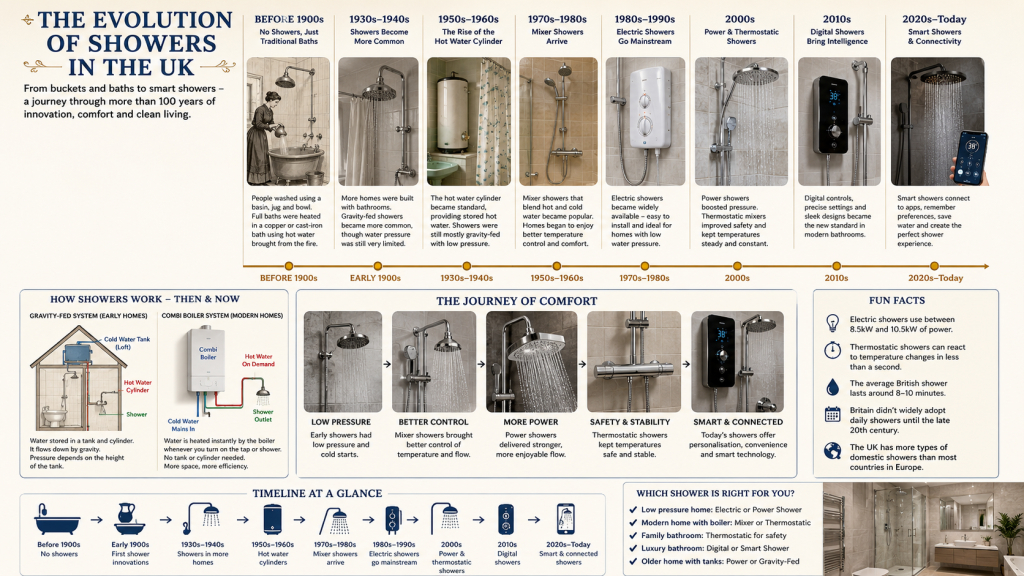
Until well into the 20th century, most British homes did not have showers at all. A weekly bath was considered perfectly normal, with hot water heated in a copper cylinder or by coal fires.
As central heating became common during the 1960s and 1970s, showers slowly gained popularity.
However, unlike many European countries where high-pressure water systems were already widespread, Britain still relied heavily on gravity-fed plumbing.
Manufacturers therefore developed several different shower designs to suit different water systems. Many of these remain in use today, which explains why there is no single “British shower.”
.
Electric Shower
Perhaps the most recognisable British shower.
How it works
An electric shower is connected directly to the cold-water supply.
When switched on, water flows through a powerful electric heating element inside the unit before reaching the shower head.
It heats only the water you use.
No hot-water tank or boiler is required.
Advantages
➕ Unlimited hot water
➕ Works even if the boiler breaks
➕ Energy efficient for short showers
➕ Popular in smaller homes
Disadvantages
➖ Lower water pressure
➖ Temperature varies with water flow
➖ Requires a dedicated high-power electrical circuit
How to use
1️⃣ Press the power button
2️⃣ Select the desired heat setting
3️⃣ Adjust the flow control
4️⃣ Wait a few seconds for the temperature to stabilise
Because the heater has a fixed power output, reducing the water flow makes the water hotter.
.
Mixer Shower
The most common system in modern homes.
How it works
A mixer shower combines hot and cold water supplied by your boiler or hot-water cylinder.
The water is already heated before reaching the shower.
Advantages
➕ Excellent temperature control
➕ Powerful water flow
➕ Simple operation
➕ Modern appearance
Disadvantages
➖ Depends on the boiler
➖ Hot water can run out if supplied by a cylinder
How to use
Turn one control to start the water.
Turn another to adjust the temperature.
Many thermostatic mixer showers automatically maintain the selected temperature.
.
Thermostatic Shower
One of the safest options.
It is actually a special type of mixer shower.
A thermostat constantly measures the water temperature.
If someone flushes a toilet or opens a tap elsewhere in the house, the shower automatically adjusts the hot and cold water mix to maintain the chosen temperature.
Advantages
➕ Prevents sudden temperature changes
➕ Excellent for families
➕ Very safe for children
.
Power Shower
Designed for older gravity-fed plumbing systems.
How it works
A power shower mixes hot and cold water while an electric pump boosts the pressure.
The result is a much stronger shower.
Advantages
➕ Excellent pressure
➕ Great for older houses
➕ Luxury feel
Disadvantages
➖ Uses more water
➖ More expensive to install
➖ Pump produces some noise
.
Digital Shower
A relatively modern innovation.
Instead of traditional controls, a digital shower uses electronic controls.
Some models even include:
- wireless controls
- smartphone apps
- programmable temperatures
- warm-up timers
- voice assistant integration
The mixing valve is usually hidden elsewhere in the house.
Only a stylish control panel remains visible.
.
Smart Shower
The newest generation.
Many premium systems can:
- remember favourite temperatures
- monitor water usage
- schedule shower times
- connect to smart home systems
- start remotely
Luxury homes increasingly feature these systems.
.
Gravity-Fed Shower
Found in many older British homes.
How it works
Cold water comes from a storage tank in the loft.
Hot water is stored in a cylinder, usually located in an airing cupboard.
Water pressure depends entirely on gravity.
Advantages
➕ Reliable
➕ Simple plumbing
Disadvantages
➖ Low pressure
➖ Flow depends on the height of the water tank
➖ Often benefits from a shower pump
.
Combination Boiler (Combi) Shower
Now the standard in many newer homes.
A combination boiler heats water instantly whenever a tap or shower is opened.
No hot-water cylinder is required.
Advantages
➕ Unlimited hot water
➕ Compact
➕ Efficient
➕ No loft tank
Disadvantages
➖ Pressure depends on the incoming mains water supply
➖ Multiple showers used at once may reduce performance
.
Which Shower System Do I Have?
A few simple clues can help identify your system.
Electric Shower
- Large white box mounted on the wall
- Electrical pull switch nearby
- Cold-water supply only
- Usually labelled with power (e.g. 9.5 kW)
Mixer Shower
- No electrical cable entering the shower
- Usually connected to exposed chrome pipes or concealed plumbing
- Relies on the home’s boiler
Power Shower
- Sounds louder when running
- Strong pressure even in older homes
- Often found with hot-water cylinders
Gravity-Fed System
- Cold-water tank in the loft
- Hot-water cylinder in the airing cupboard
- Lower water pressure
Combi Boiler
- No loft tank
- No hot-water cylinder
- Instant hot water throughout the house
.
Why Are There So Many Different Types?
The answer lies in Britain’s housing history.
Many homes built before the 1990s still retain older plumbing systems, while newer properties are designed around modern combination boilers.
Rather than replacing every home’s plumbing, manufacturers developed shower systems to work with whatever water supply was already installed.
As a result, Britain ended up with one of the widest varieties of domestic shower systems in Europe.
.
Which Shower Is Best?
| Shower Type | Pressure | Hot Water | Best For |
|---|---|---|---|
| Electric | ⭐⭐⭐☆☆ | Unlimited | Flats and smaller homes |
| Mixer | ⭐⭐⭐⭐☆ | Boiler dependent | Modern family homes |
| Thermostatic | ⭐⭐⭐⭐⭐ | Boiler dependent | Families with children |
| Power Shower | ⭐⭐⭐⭐⭐ | Cylinder dependent | Older gravity-fed homes |
| Gravity-Fed | ⭐⭐☆☆☆ | Cylinder dependent | Traditional houses |
| Digital | ⭐⭐⭐⭐⭐ | Boiler dependent | Luxury bathrooms |
| Smart Shower | ⭐⭐⭐⭐⭐ | Boiler dependent | High-end smart homes |
.
Fun Facts
- Britain didn’t widely adopt daily showers until the late 20th century.
- Electric showers are far more common in the UK than in most European countries.
- The average electric shower uses between 8.5 and 10.5 kW of electricity.
- Some modern digital showers can be controlled from your smartphone.
- A thermostatic shower can react to temperature changes in a fraction of a second.
- Many British bathrooms still combine plumbing technologies that span more than 70 years.
.
Final Thoughts
British showers may seem confusing at first, but each type reflects the country’s unique plumbing history and the gradual evolution of domestic water systems. From simple gravity-fed showers in traditional homes to app-controlled smart showers in modern properties, every system was developed to meet the needs of its time.
Once you understand the difference between an electric, mixer, power or thermostatic shower, using them becomes second nature. And if you’re planning to buy or renovate a home in the UK, knowing which shower system is installed can help you make informed decisions about comfort, efficiency and future upgrades.