

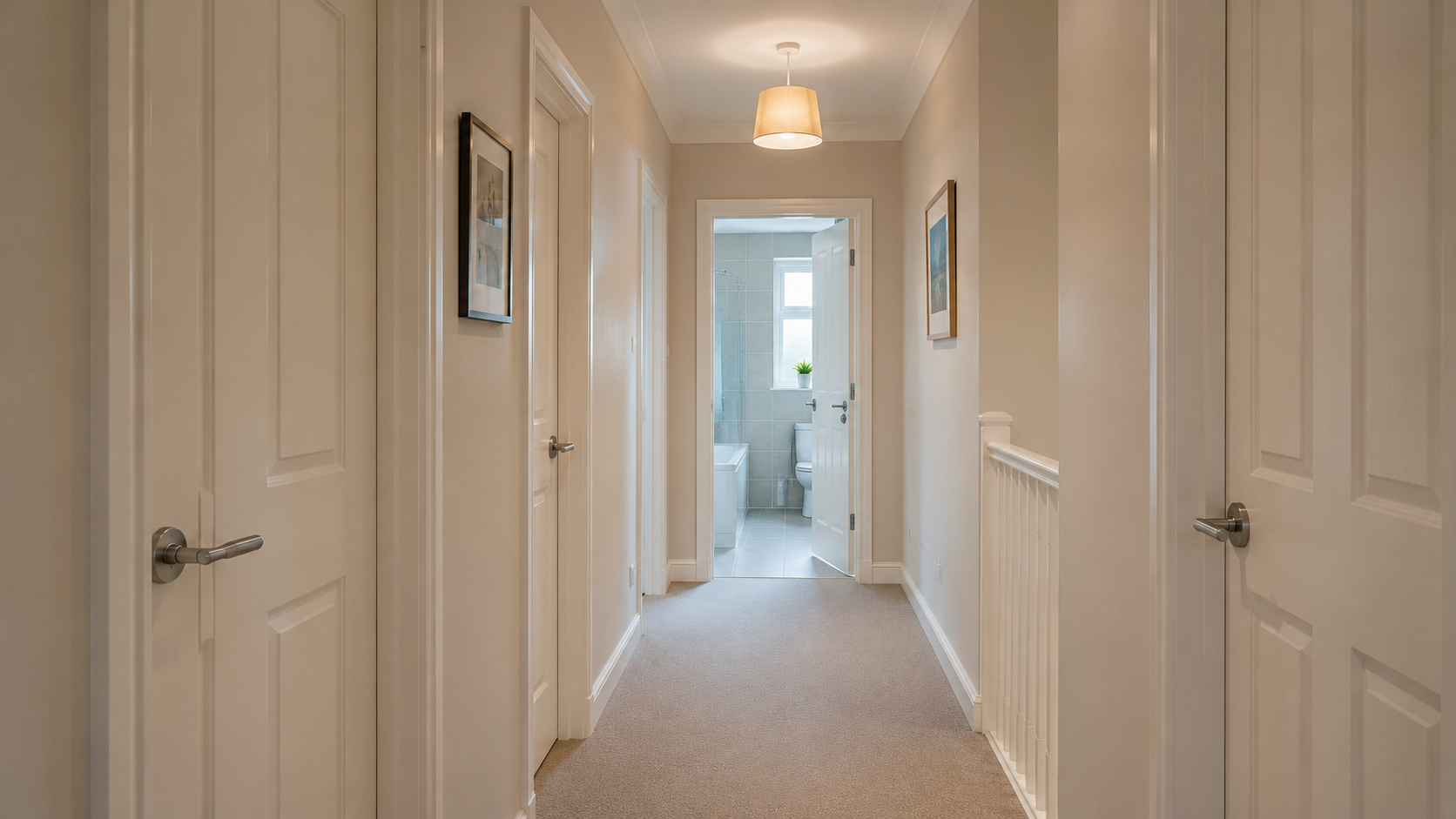
Why So Many Internal Doors in British Homes Don’t Have Locks
If you move to the UK from Germany, Austria, Switzerland or another part of continental Europe, there is a small detail about British houses that can produce a surprisingly large culture shock.
You walk into your new bedroom, close the door and try look for the door.
There is no key – there is not even a lock…
You check the next bedroom.
No lock there either.
The living room? No.
Kitchen? No.
Bathroom?
Finally, a lock! 🔐
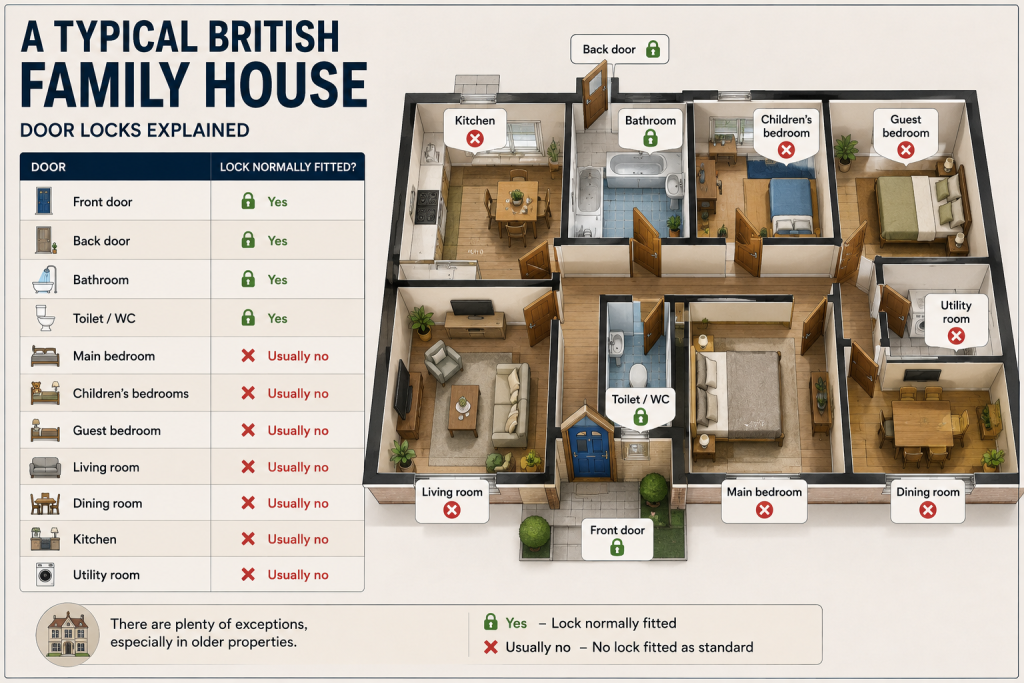
In many British homes, particularly modern houses, ordinary internal doors simply aren’t fitted with locks. Bathrooms and toilets normally have privacy locks, while bedrooms, living rooms and other internal rooms often have nothing more than a standard latch.
For someone accustomed to continental European homes, this can initially feel rather strange. So why does Britain do things differently?
.
First: Is It Really True That UK Internal Doors Don’t Have Locks?
Broadly speaking, yes, but it isn’t a rule that internal doors cannot have locks.
There is no universal British prohibition on putting a lock on your bedroom door.
Instead, this is primarily a difference in building tradition, expectations and hardware.
.
.
Compare That With Germany
The difference becomes obvious when you look at a typical German house.
Traditional German internal doors commonly have a mortice lock built into the door, often with an old-fashioned room key.
That means a bedroom door may have:
Handle + latch + key-operated lock
even if the owner hardly ever locks it.
In Britain, the equivalent door commonly has:
Handle + latch
and that’s it.
The difference isn’t necessarily that Germans constantly lock themselves into their bedrooms. The locking mechanism is simply a normal part of traditional continental European door furniture.
.
Why Don’t British Bedroom Doors Have Locks?
There isn’t one grand historical decision behind it. Nobody in Westminster declared that British families had enjoyed quite enough privacy.
It’s largely the result of several traditions developing together.
1. The Family Home Was Treated as One Private Space
Historically, a British house was regarded as the family’s private domain.
The important security boundary was therefore the outside of the house.
Front and back doors needed substantial locks because they separated the household from the outside world.
Inside that secure boundary, individual rooms didn’t necessarily need another layer of security.
A closed bedroom door effectively meant:
“This is private. Please knock.”
Privacy depended more on social convention than a key.
.
2. A Closed Door Is Supposed to Mean Something
This is probably one of the biggest cultural differences.
Within many British households, closing a bedroom door is itself a request for privacy.
You knock.
You wait.
Then you enter.
At least, that’s the theory. Anyone who has lived with children, teenagers, siblings, cats or particularly enthusiastic relatives will know that theory and reality occasionally occupy different postcodes. 😄
.
3. Internal Locks Cost More
There’s also a wonderfully mundane explanation.
A basic internal latch is cheaper and simpler than installing a complete mortice lock and supplying keys.
Multiply that difference across perhaps ten internal doors in a house and developers can save money.
Modern British housing construction has therefore reinforced the tradition of simple internal doors fitted with basic tubular or mortice latches.
If buyers don’t expect bedroom locks, builders have little incentive to install them.
.
Why Do Bathrooms Have Locks?
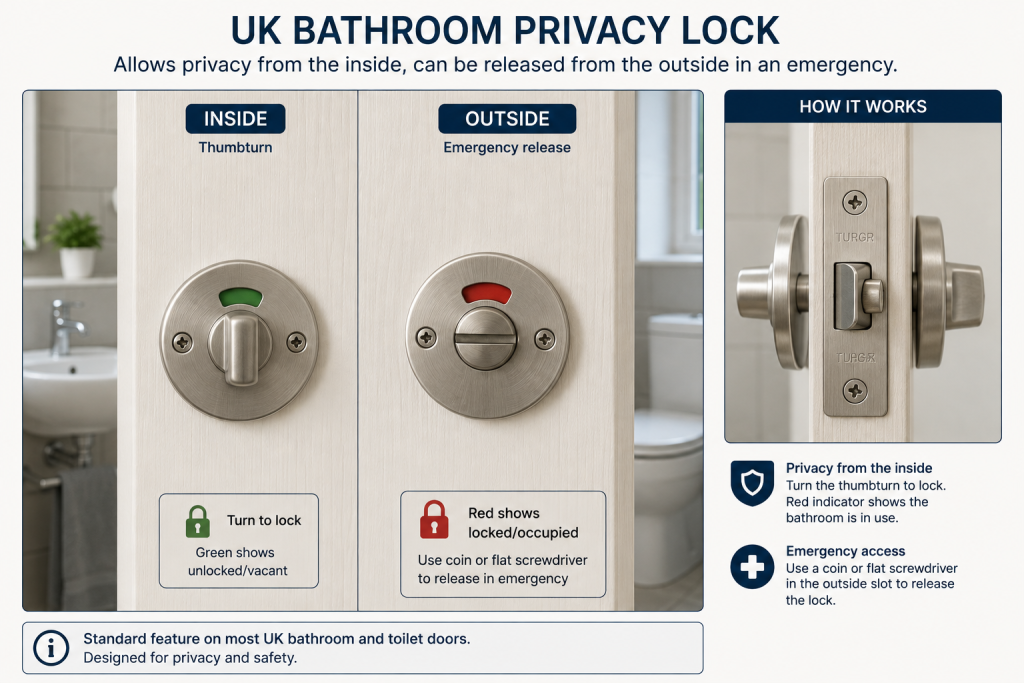
Bathrooms are different because there is an obvious expectation of immediate personal privacy.
Nobody wants the British system of polite knocking tested halfway through a shower.
Bathroom and WC doors therefore commonly have privacy locks.
These usually use a thumb-turn on the inside rather than a conventional key.
Outside there may be an emergency release that can be opened with a coin or screwdriver.
That’s deliberate.
If somebody becomes ill, falls or a child accidentally locks themselves inside, another person can open the door.
.
But What About Bedrooms?
Bedroom locks certainly exist in Britain.
You’ll commonly encounter them in:
- Hotels
- Hostels
- Student accommodation
- Houses in Multiple Occupation (HMOs)
- Lodging arrangements
- Shared accommodation
- Some older houses
- Certain rented properties
The situation changes when several unrelated adults live independently under one roof.
Then a bedroom isn’t simply another room within a family home. It may effectively be someone’s personal living space containing valuables, documents, computers and other possessions.
A lock suddenly becomes much more useful.
.
Older British Houses Can Be Different
Walk into a Victorian or Edwardian property and you may discover something interesting.
The bedroom doors do have keyholes.
Older British internal doors were frequently fitted with traditional mortice locks.
The problem is that after a century of ownership changes, renovations and enthusiastic redecorating, the keys have often vanished.
You may therefore find a beautiful 120-year-old brass keyhole with absolutely no idea where the corresponding key went.
It is architectural archaeology in miniature.
.
What About Fire Safety?
This is another area where people sometimes assume locks are prohibited.
The real issue isn’t simply whether a door can lock. What matters is whether people can escape safely.
This becomes particularly important in rental accommodation, HMOs and buildings where fire doors or escape routes are involved.
A badly chosen lock that requires someone to hunt for a key before escaping can create an obvious hazard.
Modern privacy arrangements therefore often favour locks that can be released easily from inside.
.
Fire Doors Are Not the Same as Locked Doors
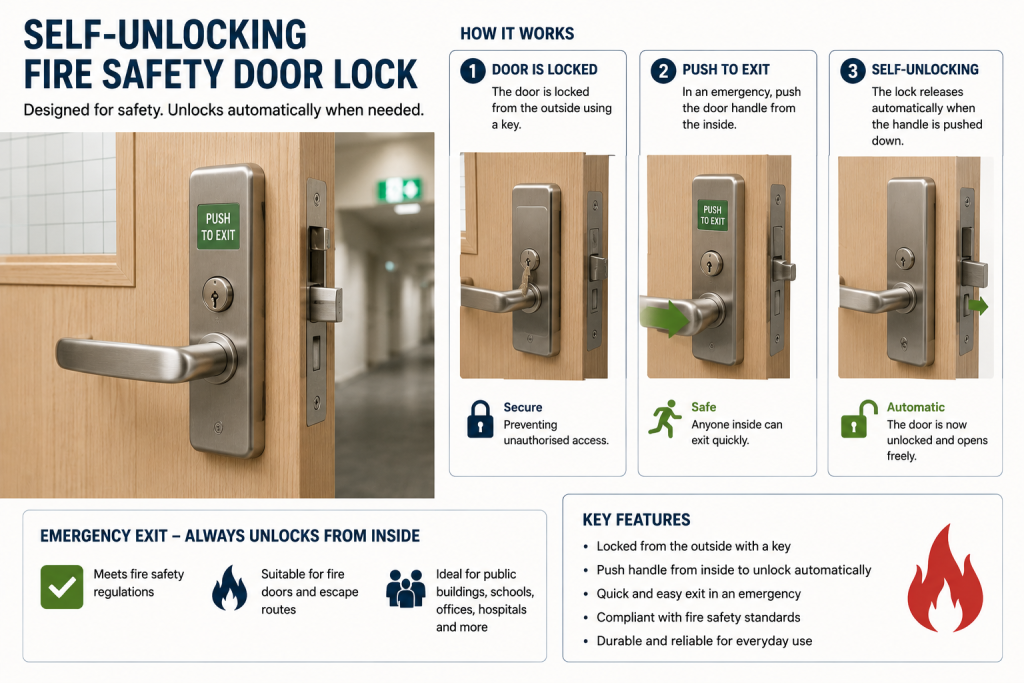
British houses may also contain internal fire doors, particularly around certain protected routes or following alterations such as loft conversions.
A fire door is designed to resist the spread of smoke and fire for a specified period.
That does not automatically mean it should be locked.
Its job is fire separation rather than privacy or security.
.
Can You Add a Lock to Your Bedroom Door?
If you own the property, generally you can fit appropriate internal door hardware, subject to any relevant building and fire-safety considerations.
Options include:
🔐 Privacy thumb-turn locks
🔑 Mortice locks
🚪 Lockable door handles
🔒 Bedroom sashlocks
For an ordinary family bedroom where the goal is simply stopping people wandering in, a privacy lock that can be opened easily from inside is often more practical than turning the bedroom into Fort Knox.
If you’re renting, however, don’t start drilling holes into doors without checking the tenancy conditions and getting permission where required.
.
UK vs Germany: The Quick Comparison
| Feature | 🇬🇧 United Kingdom | 🇩🇪 Germany |
|---|---|---|
| Bedroom door lock | Often absent | Common |
| Internal door key | Uncommon in modern homes | Traditionally common |
| Bathroom lock | Usually yes | Usually yes |
| WC lock | Usually yes | Usually yes |
| Front-door security | High priority | High priority |
| Privacy expectation | Closed door / knocking | Closed door, often with lock available |
| Typical modern bedroom door | Handle + latch | Handle + lock case |
| Keyhole on internal doors | Less common | Very common |
.
Does That Mean British Homes Have Less Privacy?
Not necessarily.
It’s more accurate to say that privacy is expressed differently.
In Germany, the physical door hardware often provides the option of locking a room.
In Britain, household privacy has traditionally relied more heavily on convention:
Door open = come in.
Door closed = knock first.
The amount of actual privacy therefore depends much more on the people living in the house than on whether the bedroom door contains a keyhole.
A considerate household with unlocked doors can provide considerably more privacy than an inconsiderate household equipped like a medieval castle.
.
The Curious British Mixture
This is another example of how British houses can surprise people arriving from continental Europe.
Britain has some extremely secure external doors, sophisticated multi-point locking systems, alarms, CCTV and doorbell cameras.
Then you walk upstairs and discover that the bedroom door is secured by…
absolutely nothing.
The house itself is the secure box. The rooms inside it traditionally aren’t individual secure boxes.
And that distinction explains much of the difference.
.
Final Thoughts
The lack of locks on bedroom and other internal doors in many British homes isn’t the result of a law banning them. It’s mainly a product of housing tradition, cost, family culture and different expectations about privacy.
Bathrooms and toilets need obvious privacy, so locks are standard. Bedrooms traditionally rely on a simpler rule:
Close the door and everyone else is expected to knock.
For someone arriving from Germany, where even an ordinary bedroom door may contain a proper mortice lock and key, the British approach can initially feel rather exposed.
But after living in the UK for a while, the system starts to make more sense.
And if someone still refuses to knock?
Well…
Perhaps it’s time for a trip to the DIY shop. 🔐🚪