

Writing Numbers in the UK vs Germany
Why a Decimal Point Can Cost You Thousands!
For anyone moving between Germany and the United Kingdom, one of the smallest differences can also be one of the most confusing: how numbers are written.
At first glance, “1,234.56” and “1.234,56” may look almost identical. However, in one country it means one thousand two hundred and thirty-four pounds, while in the other it could easily be misunderstood if you’re unfamiliar with the local convention.
Add in differences in handwriting, dates and official forms, and it’s easy to see why newcomers occasionally make expensive mistakes.
Let’s explore the fascinating differences.
.
Writing Numbers by Hand
Although the digits themselves are the same worldwide (0 to 9), several handwritten styles differ between Germany and the UK.
The Number 1
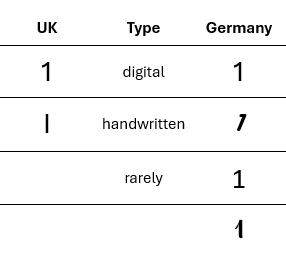
United Kingdom 🇬🇧
British handwriting usually keeps the number 1 very simple.
Example: see illustration above
without the base or decorative top stroke.
It is quicker and often easier to distinguish from the number 7.
Germany 🇩🇪
Many Germans write the number 1 with:
- A small upward stroke
- A vertical line
- Sometimes a base line
Example: see illustration above
It can resemble a small “7” without the horizontal bar.
This style is commonly taught in German schools.
.
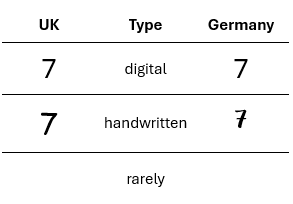
The Number 7
.
United Kingdom 🇬🇧
Most people simply write: see illustration above
without any crossbar.
The crossed 7 certainly exists, but it’s far less common.
Germany 🇩🇪
Many Germans add a horizontal crossbar.
Example: see illustration above
This prevents confusion with the handwritten number 1.
.
The Number 9
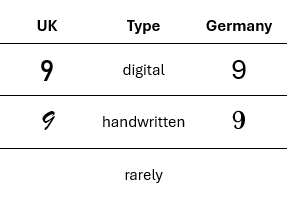
German handwriting sometimes produces a very rounded “9”, whereas British writers often leave a longer descending tail.
Both are perfectly acceptable.
.
Thousands Separators
Here’s one of the biggest differences.
United Kingdom 🇬🇧
The UK uses:
Comma (,)
to separate thousands.
Example:
| Number | UK |
|---|---|
| One thousand | 1,000 |
| Ten thousand | 10,000 |
| One million | 1,000,000 |
.
Germany 🇩🇪
Germany uses:
Dot (.)
for thousands.
Example:
| Number | Germany |
| One thousand | 1.000 |
| Ten thousand | 10.000 |
| One million | 1.000.000 |
.
Decimal Numbers
This is where many people become confused.
United Kingdom 🇬🇧
Decimals use:
Decimal point (.)
Example: £12.50
Three and a half: 3.5
One thousand and a half: 1,000.5
Germany 🇩🇪
Decimals use:
Comma (,)
Example: 12,50 €
Three and a half: 3,5
One thousand and a half: 1.000,5
Exactly the same value, written differently.
.
A Quick Comparison
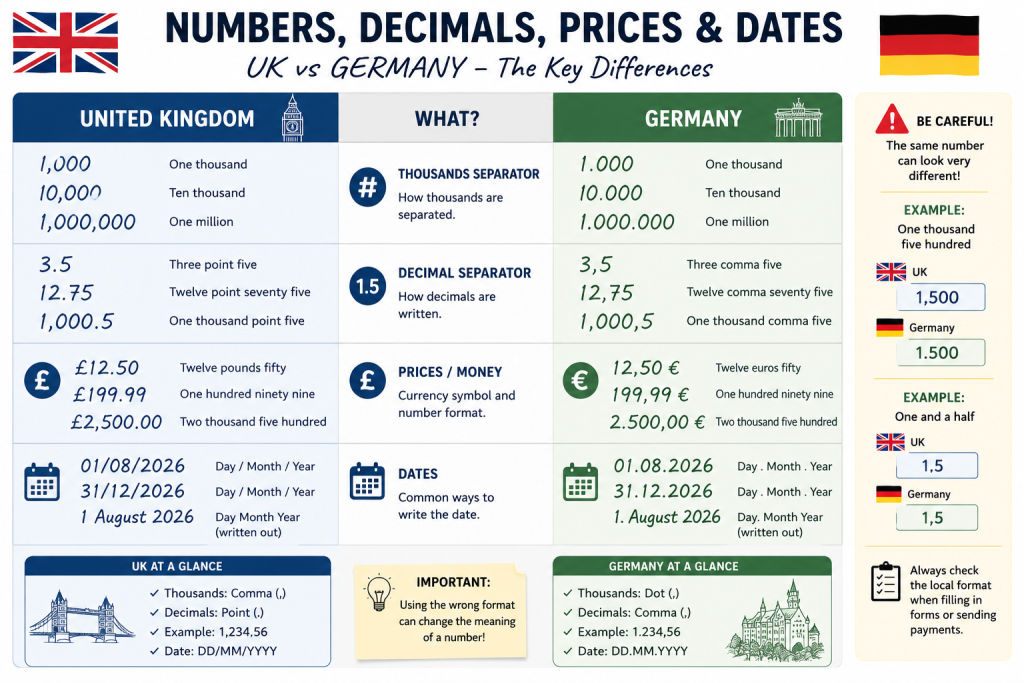
.
Writing Money
United Kingdom 🇬🇧
Currency symbol comes first.
Examples:
£12.50
£199.99
£2,500.00
Germany 🇩🇪
Currency symbol after the numbers
Usually written:
12,50 €
199,99 €
2.500,00 €
Notice again:
- Decimal comma
- Thousands dot
- Currency symbol after the number
.
Dates
Another area that causes confusion.
United Kingdom 🇬🇧
The most common format is:
Day / Month / Year
Examples:
01/08/2026
31/12/2026
Some organisations prefer:
1 August 2026
This avoids any confusion.
.
Germany 🇩🇪
Germany also uses:
Day.Month.Year
Examples:
01.08.2026
31.12.2026
Notice the dots instead of slashes.
.
International Format 🌐
Increasingly, businesses and IT systems use:
YYYY-MM-DD
Example:
2026-08-01
This ISO format avoids misunderstandings worldwide.
.
Time
Fortunately, both countries commonly use the 24-hour clock.
Example:
14:30
18:45
Although British people often say:
2:30 pm
6:45 pm
in everyday conversation.
.
Official Forms
If you’re completing forms after moving countries, always remember:
In the UK:
- Decimal point
- Thousands comma
In Germany:
- Decimal comma
- Thousands point
Using the wrong separator could completely change the value you’re entering.
For example:
1,500
means one thousand five hundred in the UK.
But a German reader may initially interpret the comma as a decimal separator if the context is unclear.
Similarly:
1.500
is one thousand five hundred in Germany, but in the UK it may be mistaken for one and a half.
.
Calculator and Computer Keyboards
Modern computers usually adapt automatically to the language or regional settings.
For example:
English (UK)
1,234.56
German
1.234,56
Spreadsheet software such as Microsoft Excel will also change separators depending on your regional settings.
.
Tips for Newcomers
If you’ve recently moved between Germany and the UK:
- Double-check large numbers before submitting forms.
- Be especially careful with bank transfers, invoices and tax documents.
- Write out months (for example, “1 August 2026”) if there is any risk of confusion.
- Follow the local format when preparing official documents.
These small adjustments can help avoid misunderstandings and make paperwork much smoother.
.
Final Thoughts
Although British and German numbering systems use the same digits, the way they are written differs in several important ways. Decimal points become commas, thousands separators swap places, dates use different punctuation, and even handwritten numbers can look surprisingly different.
Once you become familiar with these conventions, switching between the two systems becomes second nature. Whether you’re filling in a bank form in London, reading a utility bill in Berlin or writing a cheque in Edinburgh, understanding these differences ensures your numbers always say exactly what you mean.